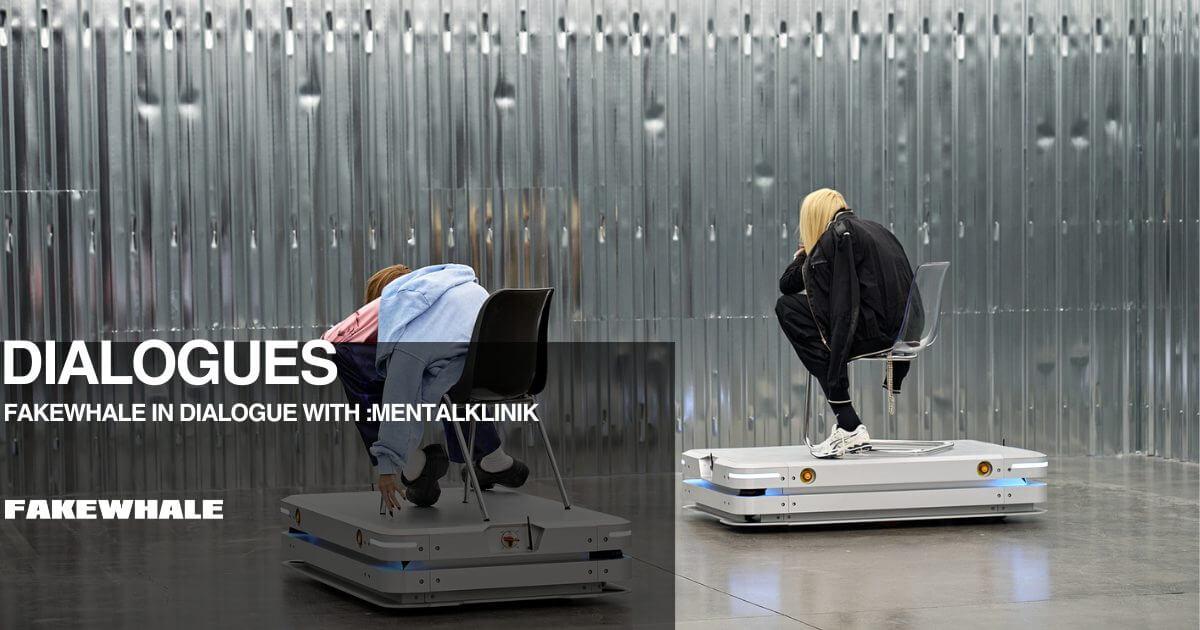
Fakewhale Studio, Output XA271, 2026
Active methods require explicit user cooperation, blinking, smiling, or moving the head according to randomly generated instructions, and are still widely used in high-risk contexts such as bank onboarding.
Passive methods are completely transparent to the user and analyze a series of involuntary signals: the face’s natural micro-movements, blood flow causing imperceptible color variations in the skin, the three-dimensional texture of the skin itself, the perspective distortion created when the device approaches the face, and even behavioral patterns such as how the phone is held.
In 2026, the most advanced solutions, such as those from Paravision, Facia, and FaceTec, achieve attack detection rates above 99% with false positive rates below 0.1%, according to independent tests by accredited laboratories. (…)
Your Face Is Your New Password: The Invisible Technology Watching You

Fakewhale Studio, Output XA265, 2026
In 2026, facial recognition has become a silent but constant presence in our daily lives: it unlocks phones in a second, lets passengers breeze through airport security without showing documents, authorizes payments with a simple glance, and in many contexts monitors public spaces. Yet most people have a very simplified idea of how this technology actually works.
They imagine a camera snapping an image and comparing it against a database of faces, like something out of a science-fiction movie. The reality is far more sophisticated, mathematical, and in some respects surprising. To truly understand what happens when a facial recognition system “sees” a person, one must follow step by step the long journey that transforms a face into a verified identity. (…)

Fakewhale Studio, Output XA268, 2026
Everything begins with the detection phase. When a camera or sensor frames a scene, the system must first determine whether and where a face is present. This is no simple task: the face may be partially covered, poorly lit, angled dramatically, or in motion. Modern algorithms, based on increasingly sophisticated convolutional neural networks, can draw a virtual box around a face even under difficult conditions, and they do so in just a few milliseconds.
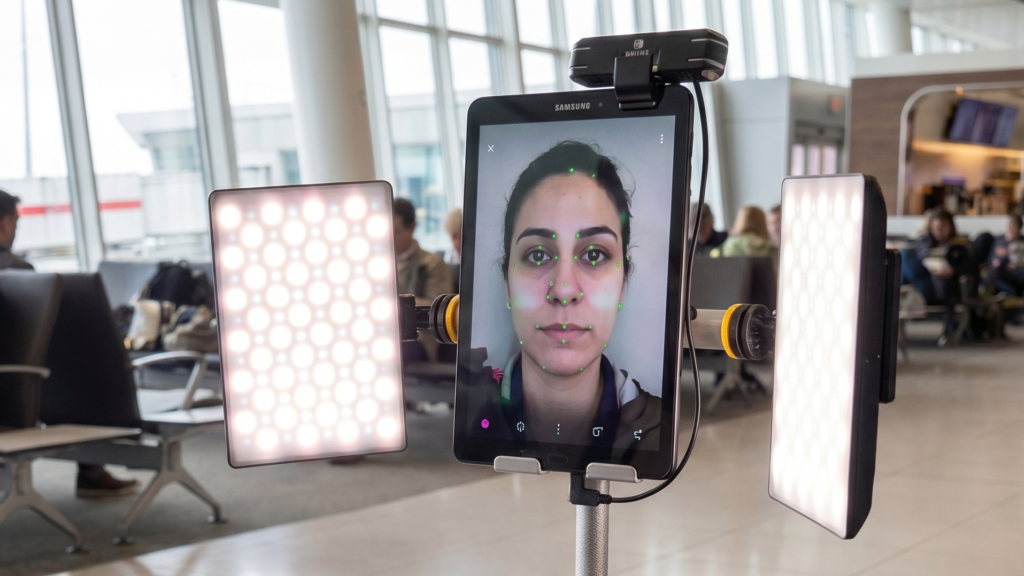
Once the face is isolated, the more delicate work begins: landmark mapping. The system identifies dozens or hundreds of key points, the corners of the eyes, the pupils, the tip of the nose, the contour of the lips, the cheekbones, the line of the jaw, and uses them to calculate distances, angles, curvatures, and geometric ratios. In the most advanced systems, which use depth sensors or structured light, a third dimension is added: the face is reconstructed in 3D, capturing micro-contours and skin textures that are unique to each individual. (…)
Explore the full Insight↓
THE DUMBING DOWN PROPHECY: Artificial Intelligence, Cognitive Offloading, and the Birth of Second Order Thought

Fakewhale Studio, Output XA257, 2026
For millennia, biological intelligence paid an invisible tax to execution. Every cognitive act (calculation, memorization, synthesis, verification, transcription, classification) consumed neural resources that, in the absence of external instruments, could deploy nowhere else. The human brain operates as a finite-capacity system: each cognitive function mobilizes attentional bandwidth unavailable to other functions. Intelligence invested in execution is intelligence withdrawn from reflection, conceptual mapping, cross-domain synthesis, and the kind of thought that operates on processes rather than inside them. This is a structural condition, not a contingent limitation. (…)

Fakewhale Studio, Output XA262, 2026
The debate around artificial intelligence concentrates almost entirely on loss. Memory will atrophy. Calculation skills will erode. Competencies that defined daily cognitive labor will be abandoned. This fear follows a coherent internal logic: if a function is delegated, it ceases to be exercised; if it ceases to be exercised, the capacity for it deteriorates. But the logic stops before articulating the more consequential question: what happens to the cognitive resources released by delegation? What becomes operatively possible when execution stops monopolizing available attention?
Cognitive delegation can produce dependency; this is real, documented, and merits analysis. It can also produce availability: a portion of attentional capacity that becomes accessible for functions which, in the prior configuration, lacked sufficient operative space. The profile of human intelligence is plastic. It adapts to the instruments it uses, the structures it inhabits, the demands that its environment places upon it. With artificial intelligence, the environment is reconfiguring those demands substantially, and the reconfiguration concerns not only what we do, but which type of thought is called upon to do it. (…)
Explore the full Article↓