
Fakewhale Studio, Untitled, 2024
It would be incredible to know what’s inside a black hole, to get close enough to hear it hum. We always talk about them with this sort of abstract detachment, as if we already knew we were doomed to imagine certain things rather than ever experience them in our own skin.
What is the blackness—the end—the absorption—the collapse—the compression of matter? What are these things, really? Maybe black isn’t even a color, but the way reality says: “Here, I can’t be what you know anymore.”
And yet we insist on talking about these things as if we could truly understand them, as if words, these words full of folds and uncertainties, were enough to bridge a distance that is physical, mental, emotional. Every day we choose to fall into temptation and draw closer to what we can’t touch, hurting ourselves again and again with the desire for a knowledge that surpasses us.
Still, somewhere inside us remains the idea that not everything we cannot see is necessarily unreachable. That maybe one day, when we stop demanding to understand everything, we might at least feel something instead: a tremor, a faint distant noise, a pressure on the mind. A hint.
And perhaps, something we’ll only realize later, the truly interesting part isn’t what lies inside a black hole, but what happens to us when we try to imagine it.(…)
DIALOGUES/ Luca Lo Pinto, The Screen is a Muscle. In conversation with Matteo Giovanelli

The screen is a muscle, Artissima 2025. Curated by Luca Lo Pinto. Gallerie d’Italia – Torino, 31 October – 2 November 2025. In the picture: Shahryar Nashat, Lover_00.JPEG, 2024 and Lover’s Companion, 2024 (Sylvia Kouvali, London, Piraeus). Photo: © Perottino-Piva-Castellano-Bergadano/Artissima.
During Artissima, in collaboration with the fair, Gallerie d’Italia opened The Screen is a Muscle, an exhibition curated by Luca Lo Pinto, who brought his transversal approach into the space, conceiving the group show as a choreography with short videos by Bruce Conner, Low Jack & Invernomuto, Tommy Malekoff, Vijay Masharani, Eva & Franco Mattes, Shahryar Nashat, James Richards, SAGG Napoli, Julia Scher and Anastasia Sosunova.
No narratives were needed, and there was no excessive authorial interpretation that could overshadow the videos. Lo Pinto focused on selection and an orchestral disposition as if creating musical score, with voice-over sounds created by Martina Ruggeri, which glued the sequence and creating a unique rhythm.
Each video was projected on a single wall at a time. Viewers were invited to stay for the duration of each clip, waiting for the next projection on another wall in the chamber, forced to move to the other side, and so forth. The mass of spectators was guided to stop and then move, following the rhythm of the sounds and music. Lo Pinto flipped the relationship between the work and the viewers creating a “dictatorship of the work”, which contrasts with the usual decisional power that the spectator has during a visit in a museum, where they can move freely at will. (…)

The screen is a muscle, Artissima 2025. Curated by Luca Lo Pinto. Gallerie d’Italia – Torino, 31 October – 2 November 2025. In the picture: Low Jack & Invernomuto, Mangrovia, 2024 (Pinksummer, Genova). Photo: © Perottino-Piva-Castellano-Bergadano/Artissima.
Matteo Giovanelli: Hi Luca, thank you for accepting our invitation to talk about the new group exhibition, The Screen is a Muscle, curated by you at Gallerie d’Italia in Turin. To introduce this exhibition, we would like to start with you and ask how your curatorial perspective was formed, how it developed over the years, and which experiences and encounters have influenced your conception of exhibitions and curatorship up to this point.
Luca Lo Pinto: It was a series of coincidences. I have always been very attentive to what artists said and suggested. Thus, both the first exhibitions I organized and the encounters I had were almost always born out of chance, but also out of great curiosity. Simultaneously, I was studying art history and while I was still a student, I co-founded NERO with three of my closest friends. Making exhibitions always went hand in hand with the magazine and the publishing house, a very important experience, especially for developing a broader curiosity not limited exclusively to visual art, also because the magazine was not an art magazine in the strict sense, but rather a cross-disciplinary one. It really helped me to approach the exhibition making in an obsessive and “nerdy” way without being self-referential.
MG: So you were balancing immersion in the work with a kind of critical distance.
LLP: Exactly. For example, while working on this project which takes place in Turin during an art fair, I thought carefully about how to create an exhibition that was thoughtful, experimental, and engaging, considering the enormous cultural offer that the city provides these days
MG: Looking back, how would you say your approach has evolved compared to the first exhibitions you curated?
LLP: If I compare my first exhibitions with those I organize today, there is a constant consideration of the role of the curator as that of an author. I say this without any hint of vanity or egocentrism. It is a matter of finding the right balance between authorship and ensuring that the protagonists are always the artists and their works. I have always maintained an interest in experimenting with the format and language of the exhibition. At first, I was strongly fascinated by conceptual art, and my desire was to work on ideas that were as radical as possible. In recent years, my interest has shifted towards conceiving an exhibition not so much as an idea but as an experience. Obviously, I am not referring to the commodified “immersive” exhibition model. (…)
CONTINUE READING ↓

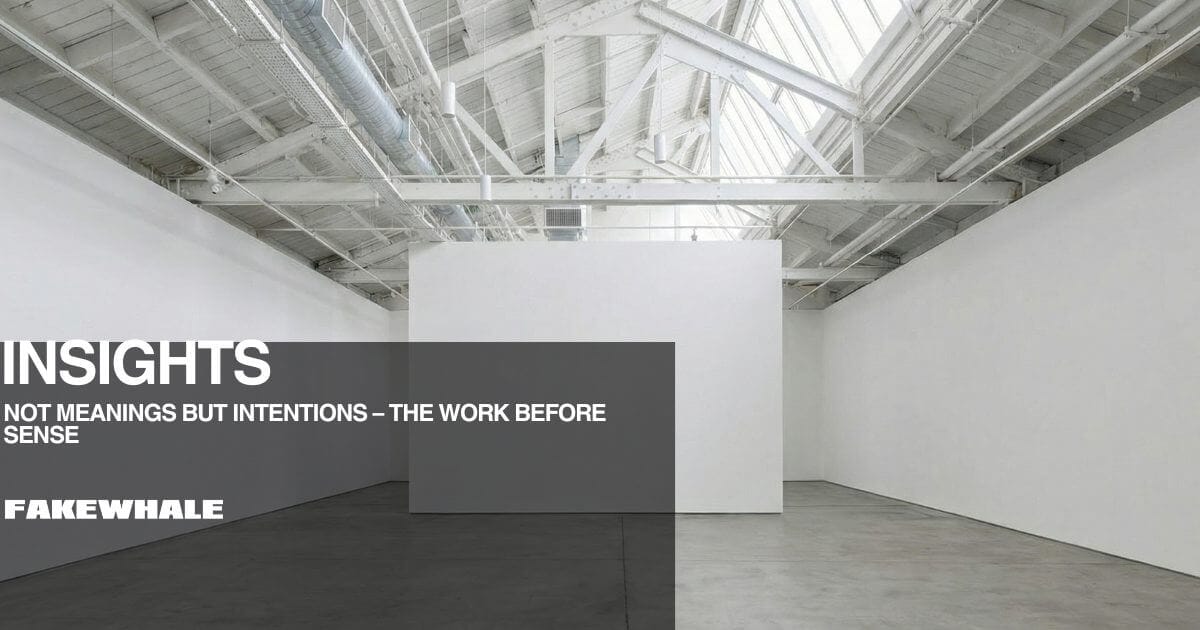
INSIGHTS/ Not Meanings but Intentions – The Work Before Sense

AI-generated image created by Fakewhale.
To speak of intention means shifting our attention from product to process, from meaning to its pre-condition. In other words, it means recognizing that every artwork emerges from a preliminary mental zone, a not-yet-codified territory in which thought has not yet assumed the form of a concept, but already contains its direction.
This dimension can be described as pre-semiotic: a space where language does not yet dominate, but begins to organize itself as potential energy.
In this sense, intention is neither a rational purpose nor a conceptual program, but a vector, a minimal orientation of thought that precedes any symbolic articulation. It is a cognitive posture, a perceptual tension, an internal movement that manifests before it is formulated.
It is not yet meaning, but no longer pure indeterminacy.
Phenomenology, useful here more as a method of suspension than as doctrine, allows us to observe this originary moment without pressing prematurely toward conceptualization. Intention cannot be captured by traditional structural analysis because it is not a structure; it is a condition of possibility for meaning.
A kind of pre-form, or a form-in-waiting. (…)
CONTINUE READING ↓
DIALOGUES/ Fakewhale in Dialogue with NONOTAK Studio

NONOTAK STUDIO, SORA ( crédit NONOTAK Noemi Schipfer & Takami Nakamoto )
Over the past decade, NONOTAK Studio has redefined the relationship between light, sound, and space, transforming architectural environments into kinetic organisms that breathe, react, and multiply perceptually. From their early audiovisual performances to their most recent monumental installations, their work crosses the threshold between the material and the immaterial, exploring how light becomes time and movement becomes language.
At Fakewhale, we had the pleasure of speaking with them, delving into the principles that animate projects such as SORA, SATELLITES, NARCISSE, SAKURA STAGE SHIBUYA, SHIRO, and COORDINATES, and reflecting on how their poetics continue to expand the boundaries of perceptual experience.

NONOTAK STUDIO, SATELLITES V.1 ( crédit NONOTAK Noemi Schipfer & Takami Nakamoto )
Fakewhale:Your work seems to constantly oscillate between order and chaos, as if light were a force trying to organize space while simultaneously dissolving it. How do you conceive this dynamic balance between technical control and perceptual loss of control?
NONOTAK Studio: Light is a big inspiration in our work and the reason we like this medium that much is its immaterial aspect and also its influence on its own environment. It can completely change the perception you have of a space and this is what interests us. We like to disrupt a space and give it a soul through motion and sound.
When we are working on the narration of a piece, we really like to play with contrast and have dynamic, violent moments as well as more dreamy and emotional moments. We like to have our audience feel different emotions when they experience one of our installations. (…)
CONTINUE READING ↓

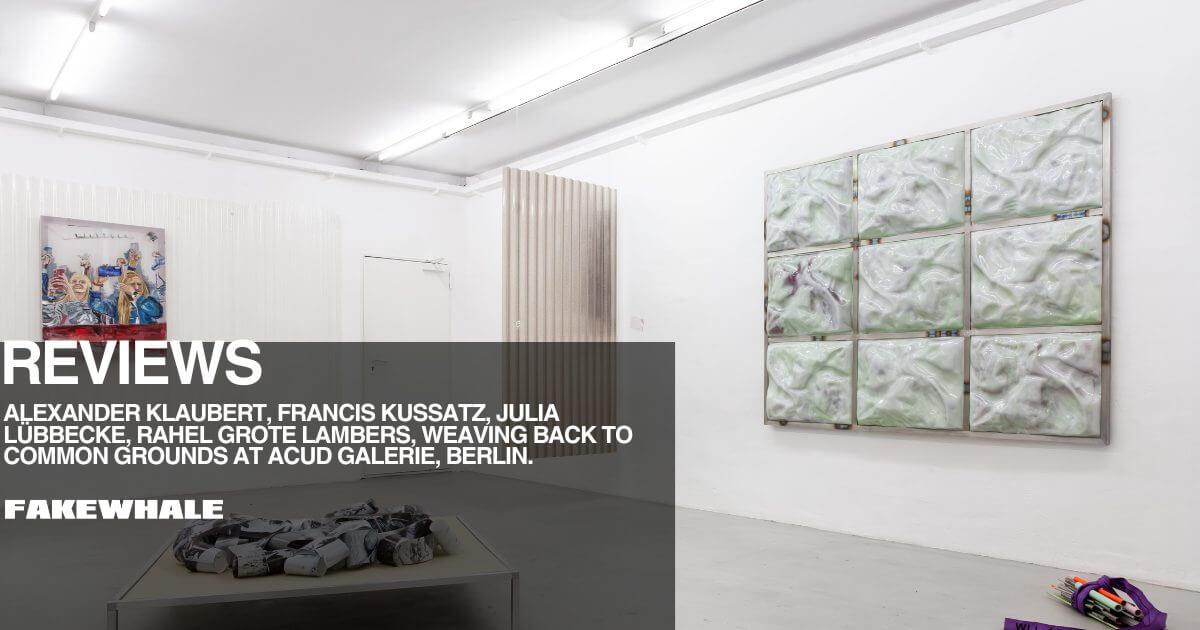
REVIEWS/ Alexander Klaubert, Francis Kussatz, Julia Lübbecke, Rahel grote Lambers, Weaving Back to Common Grounds at ACUD Galerie, Berlin.

Exhibition view: Weaving Back to Common Grounds, Alexander Klaubert, Francis Kussatz, Julia Lübbecke, Rahel grote Lambers, curated by otc collective, ACUD Galerie, Berlin.
Where does common ground begin? Beneath the soles of our feet, or in the flicker of a shared glance? Stepping into Weaving Back to Common Grounds, one word began to echo in our minds: negotiation. Not the contractual kind, but the kind whispered through gestures, hesitations, and trust. The otc collective has created something more than an exhibition, they’ve shaped a question that loops and interlaces through every work: how do we still find one another when the world keeps teaching us to drift apart?
The gallery doesn’t offer a single entrance into meaning, it unfolds like a weave, threads slipping in and out of coherence. Some works gather close; others keep their distance, quietly refusing resolution. We felt drawn not to a focal point, but to the relationships between the pieces. Each work seems to glance sideways at another, murmuring agreements, or perhaps disagreements. There is no didactic path here, only a rhythm of approach and withdrawal.

Exhibition view: Weaving Back to Common Grounds, Alexander Klaubert, Francis Kussatz, Julia Lübbecke, Rahel grote Lambers, curated by otc collective, ACUD Galerie, Berlin.
Materially, the show is tactile, threads, both metaphorical and literal, recur throughout. Some works feel like conversations paused and resumed, others like solitary reflections made public. The gestures are at once rigorous and vulnerable. The exhibition’s fabric, spatial, emotional, conceptual, is stitched together through interruptions and continuities. We sensed care in its structures, friction in its seams.
Some pieces emerge from documented exchanges and shared research. Others hold a radical independence (the kind that always captivates us), asserting their presence in quiet defiance or weary intimacy. These dynamics reveal not only collaboration, but also its emotional cost: the frictions, failures, and acts of faith that shape collective practice.
CONTINUE READING ↓
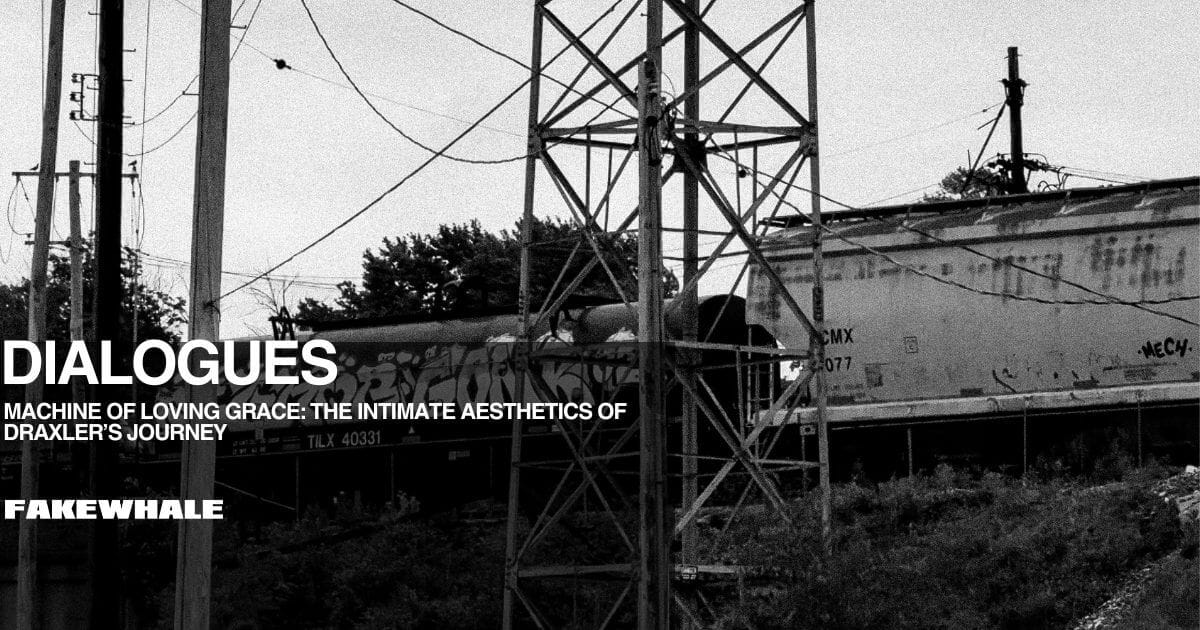
DIALOGUES/ Machine of Loving Grace: The Intimate Aesthetics of Draxler’s Journey

screenshots from the long-format video of the drive that will be featured at the event.
Fakewhale: Your artistic practice was born in a family of mechanics and carpenters, in rural Wisconsin. How present is that world in your aesthetic today, and particularly in the project C280: MACHINE OF LOVING GRACE?
Jesse Draxler: Growing up my dad was always working on some sort of vehicle, fixing, rebuilding, painting. He loves muscle cars and would drive me around in an old classic firebird. He built a go-cart out of welded steel and lawn mower machine parts when I was a kid that I ripped around on until I ran it into too many walls for it to keep going. While I never got into the mechanical side of it, the aesthetics and appreciation have always been a part of my DNA, regardless of how consciously I have been aware of its strong influence in everything I do. It feels like this project is a culmination of these collected influences that I have become more and more aware of as my career progresses. It seems appropriate that I put a perfect bit of machinery, like my c280, up on a pedestal as the object of artistic worship.

screenshots from the long-format video of the drive that will be featured at the event.
Fakewhale: The very title of the project, Machine of Loving Grace, evokes a contrast between mechanics and tenderness, structure and emotion. What is the origin of this title, and how does it connect to the psychological dimension that often runs through your work?
Jesse Draxler: The title originates from multiple points. The first connection is the 90’s band Machines of Loving Grace who I was listening to a lot around the time of the drive and after, particularly on CDs which I purchased along the route. I dig everything about the band from their sound to the aesthetics, which I integrated into some of my own logos and symbology. (…)
CONTINUE READING ↓
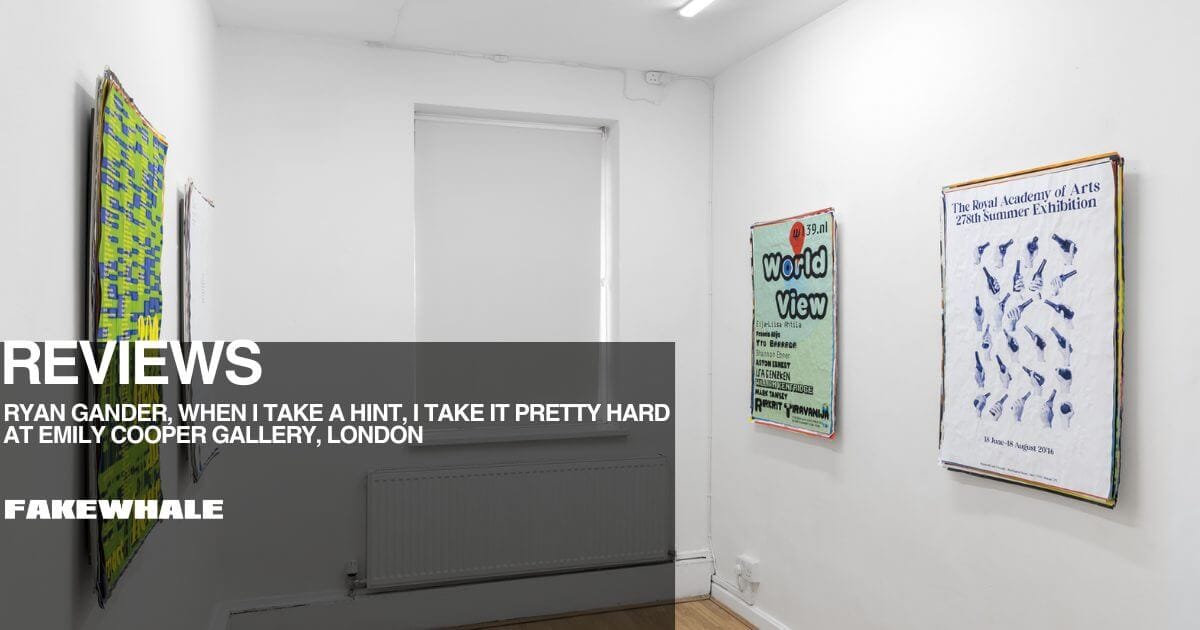
REVIEWS/ Ryan Gander, When I take a hint, I take it pretty hard at Emily Cooper Gallery, London

Exhibition view: When I take a hint, I take it pretty hard, Ryan Gander, Emily Cooper Gallery, London.
“Do our dreams keep secrets from us, even when we’re the ones who dream them?” As we crossed the gallery’s threshold, this question hummed like static in our ears. Ryan Gander’s When I take a hint, I take it pretty hard doesn’t just beckon viewers into a show, it lets them trespass through the corridors of sleepless imaginings, where ambition is restless and memory speculative. The exhibition unfolds not with bold gestures but quiet duplicity: a sculptural archive of forty-nine veiled dreams, masked beneath a single revealed face.
The Emily Cooper Gallery, in its inaugural show, embraces intimacy and intent. The atmosphere is hushed, as if the walls themselves are unsure whether to whisper or stay silent. Visitors meander slowly, drawn into proximity by the lone poster visible, the rest concealed beneath like sedimentary strata of Gander’s mind. The lighting is soft and deliberate, spotlighting this single piece, letting the rest remain a mystery just beyond reach.(…)
CONTINUE READING ↓
REVIEWS/ CTRL_ABSENCE, Skygolpe at Fellowship, London

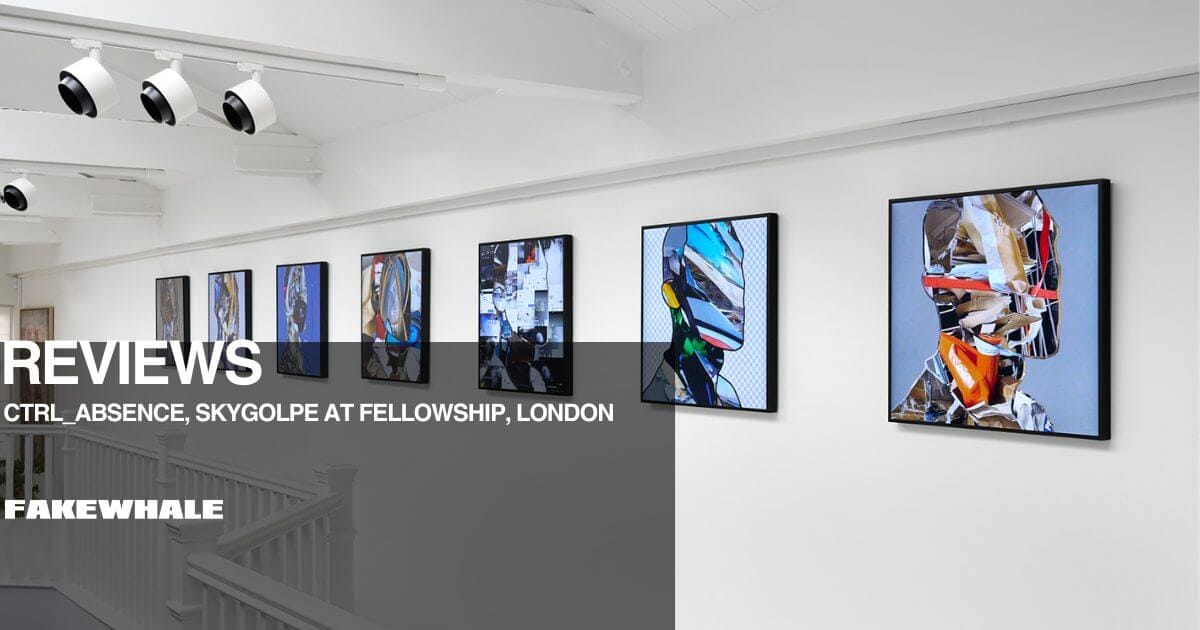
Installation view: Skygolpe, CTRL_ABSENCE, solo show at Fellowship, London. Photo courtesy of the artist and Fellowship, Ph: Reece Straw
CTRL_ABSENCE is Skygolpe’s new solo exhibition, presented in the Fellowship gallery spaces in London from 20 to 26 November 2025. The project consists of 21 unique video works and four Baryta paper prints (70×50 cm), arranged along a path that connects two levels of the exhibition space. The show examines our relationship with images, identity, and the threshold between presence and absence as it relates to artistic practice.
The silhouette, a distinctive and recurring element in Skygolpe’s digital works, reappears here as a constant presence in the physical prints as well. In every piece on display, the anonymous figure, stripped of identity and central to the artist’s ongoing research, becomes a neutral, universal form that does not depict but rather evokes.(…)
CONTINUE READING ↓
DIALOGUES/ Sovereign Art Pieces

Digital Soul | 0x4f32740cf412d647A622ba27C36fa4B76F71601f | 8.5KB | October 2023
Within Fakewhale’s ongoing research on artworks that operate as systems, Han introduces a decisive step in the lineage of on-chain practice. Each piece exists as a sovereign program that integrates image, ownership, and market logic into a single entity.
Code, protocol, and authorship converge inside a contract that functions simultaneously as artwork and interface. This convergence affirms that autonomy can emerge directly from the protocol and act as an aesthetic force.
Han’s project reads the field after a decade of standardization and platform dependency. It aligns creative expression with executable structure. Royalties become an intrinsic part of the contract’s architecture rather than an externally defined rule. Transactionality becomes part of the artwork’s living process. The entire market interface is compressed into a few kilobytes. The result is a minimal organism that performs independence while remaining entirely addressable on Ethereum.
The series rewires the mental model of NFTs. No ERC scaffolding, no token URI indirection, no external marketplace as primary venue. The script of each piece resides inside its contract source. A custom engine translates GLSL logic into JavaScript and binds rendering to the contract, while Solidity governs bids, transfers, and immutable royalties. The artwork exposes a complete cycle where generation, ownership, exchange, and record coexist within one legal and visual body.(…)
CONTINUE READING ↓

That wraps this week’s issue of the Fakewhale Newsletter, be sure to check in for the next one for more insights into the Fakewhale ecosystem!


1