AI image by Fakewhale.
For some time now, we have been circling the image as one might circle a fire at night, drawn to its warmth, wary of its power to mesmerize. We have watched it mutate, proliferate, slip from surface to surface, until it no longer simply represents the world but quietly scripts it. The image has ceased to be a window; it has become an atmosphere.
It seeps into our gestures, calibrates our desires, rehearses our emotions before we even feel them. It does not shout; it arranges. It arranges the visible and the invisible, the urgent and the negligible, the admirable and the disposable. In this choreography, common sense is no longer common, it is curated. Relevance becomes a spotlight, visibility a currency, desirability a filter applied to reality itself.
To reflect on the image today is to confront a form of soft architecture, an infrastructure of perception. Its power is not coercive but gravitational. It pulls us toward certain narratives, certain bodies, certain futures, while others dissolve at the margins. The image does not simply depict what matters; it teaches us how to matter.
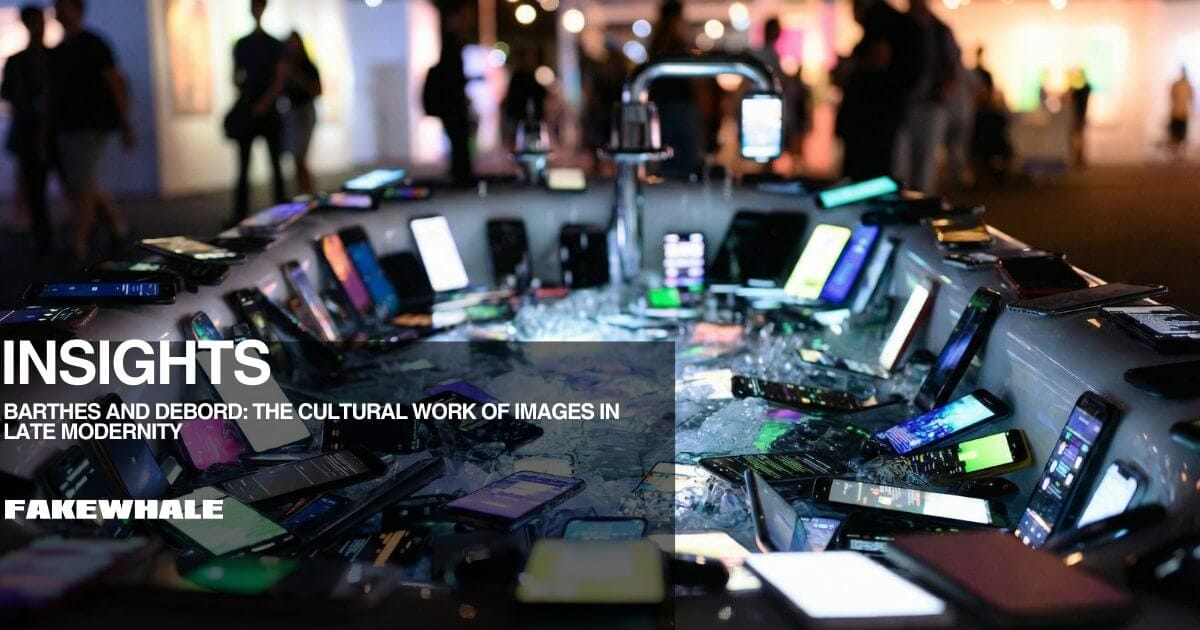
INSIGHTS/ Barthes and Debord: The Cultural Work of Images in Late Modernity

AI image by Fakewhale.
Last year, we happened to find ourselves in a park, sitting on a bench, observing an apparently banal scene. A group of people, spread across the space, all engaged in the same gesture: their gaze fixed on a screen. No direct interaction, no dialogue. Only similar postures, synchronized rhythms, minimal movements. Nothing extraordinary was taking place, and precisely for this reason the scene was eloquent. Nothing was happening, yet everything already seemed organized.
At that moment, the feeling had little to do with the use of technology and much more with something subtler. It was as if reality had become a backdrop, a passive support for a flow of images taking shape elsewhere. The park was no longer a space of experience, but a place of waiting. What mattered was happening somewhere else, within the shared visual space of screens.

AI image by Fakewhale.
That episode made clear how the image no longer functions as a representation of reality, but as a structure that precedes it and organizes it. This is precisely the point identified by Roland Barthes when he analyzes the workings of myth: the image presents itself as natural, immediate, devoid of any apparent construction. Meaning is not perceived as a cultural product, but as self-evident.
From this perspective, the image does not ask to be interpreted. It asks for adherence. Through repetition and familiarity, it establishes a common sense that imposes itself without declaring itself. A historical, social, or political value loses its origin and settles into the gaze as a given. Power operates by making itself invisible, blending into normality.
Today, this mechanism is even more evident. The images that move daily across our devices do not merely describe the world; they define its perceptual coordinates. They decide what appears relevant, what deserves attention, what exists socially. The visible becomes a criterion of truth.
Barthes identifies in this shift a decisive threshold: the moment when language ceases to be recognized as such and turns into environment. The image no longer communicates a message; it constructs a horizon. Within that space, common sense takes shape and power is exercised without needing to declare itself, acting directly on everyday perception of reality. (…)
CONTINUE READING ↓
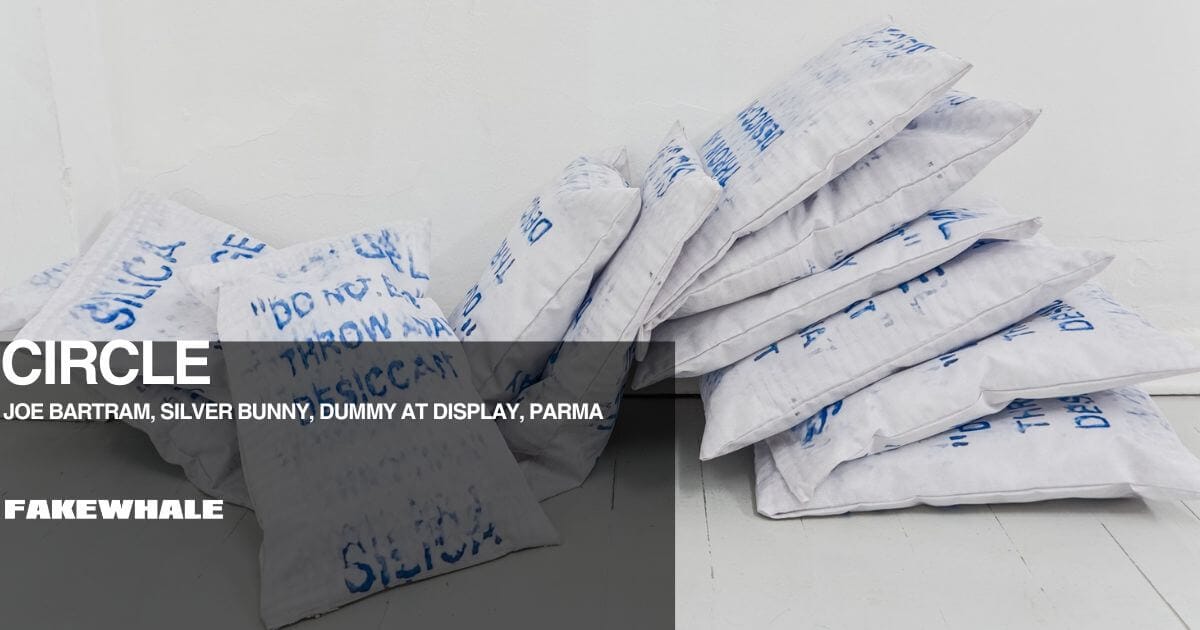
REVIEWS/ Joe Bartram, Silver Bunny, Dummy at DISPLAY, Parma

Exhibition view: Silver Bunny, Dummy, Joe Bartram, curated by Ilaria Monti, DISPLAY, Parma.
We remember the rabbit before we remember ourselves.
A cartoon creature, suspended in perpetual hunger.
A cereal box withheld. A slogan repeated.
“Silly rabbit! Trix are for kids!”
Standing at the threshold of Silver Bunny, Dummy, we ask: when did desire become scripted? When did longing learn its lines from television? Bartram’s exhibition greets us not with nostalgia, but with the residue of it , bright, smooth, seductive forms that seem to smile while withholding something darker. We enter as viewers; we remain as implicated participants. The air feels charged with recognition.
Inside DISPLAY, the space unfolds like an analog screen. The works are positioned with deliberate rhythm, each object holding its ground while glancing sideways at the next. There is a choreography at play, candies, cartoon echoes, architectural fragments, toy-like police batons, taxidermied chicks rendered uncanny, each element suspended between amusement and quiet threat. Visitors move cautiously, almost playfully, tracing the logic of repetition and exaggeration that structures the installation. The room feels at once theatrical and forensic. (…)

Exhibition view: Silver Bunny, Dummy, Joe Bartram, curated by Ilaria Monti, DISPLAY, Parma.
Bartram’s sculptures, derived from Styrofoam copy castings, carry a particular tension. These are rubber impressions taken from packaging waste, the negative molds of mass production. Materials usually destined for invisibility return as presence. What once protected commodities now becomes the commodity. Smooth surfaces gleam in color or sink into darker tonalities; they attract the eye even as they whisper of disposability. We sense the ghost of the industrial process in every contour.
This transformation is not mere replication. These forms are not copies of originals; they are imprints of circulation itself. The artist manipulates figures drawn from American consumer life, Haribo candies, cartoon characters, architectural models, building a visual grammar rooted in familiarity. Yet the familiarity curdles. Repetition becomes incantation. Play becomes discipline. The exhibition reveals how spectacle operates as an epistemic force, shaping not only what we want, but how we perceive and remember. (…)
CONTINUE READING ↓
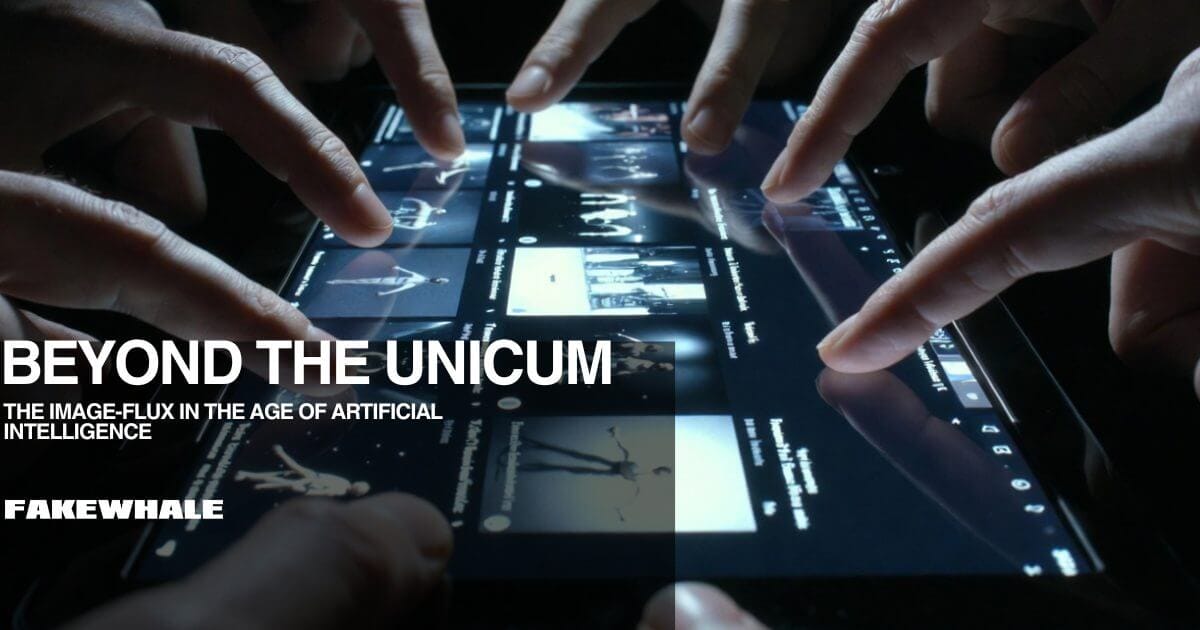
INSIGHTS/ Beyond the Unicum: The Image-Flux in the Age of Artificial Intelligence

AI image by Fakewhale.
(…) Today the constraint has moved. The image does not need to be awaited, prepared, or sought. It arrives already embedded in circulation. Artificial intelligence accelerates this transition by making generation permanently available, instantly callable, and structurally compatible with the distribution systems that govern contemporary visibility.
The decisive shift is therefore not aesthetic. It is infrastructural. The image changes regime. It becomes continuous, abundant to the point of permanence, and increasingly inseparable from the protocols that rank, sequence, and monetize it.
This is the end of the unicum in a deeper sense: not simply the end of uniqueness as rarity, but the end of the image as interruption. What emerges is a visual environment, a field in which images operate as units of flow, and in which relevance is produced through systems that continuously translate attention into hierarchy.

AI image by Fakewhale.
The scene did not suggest distraction as much as habituation. The screen had become the default surface where experience reorganizes itself during any interval that would otherwise remain empty. Waiting, commuting, resting, even lying in bed becomes an opportunity for exposure to a managed sequence of images. The image no longer competes with reality in the classical sense. It occupies the micro-temporal spaces in which reality used to settle.
In that setting, the single image loses the status of event. It becomes one element inside a stream whose dominant property is continuity. The decisive fact is not the presence of images but their uninterrupted arrival, and the way this arrival trains perception to expect the next frame as a default condition.
Artificial intelligence intensifies the same logic by increasing availability. It removes friction from production and makes novelty cheap. A sentence can generate a scene; a few tokens can generate a face; an instruction can generate a style that never existed as a material practice. This produces a visual climate in which abundance becomes stable, and stability becomes the new baseline.
Visual exception migrates away from the image and toward attention itself. The scarce resource becomes the ability to hold a gaze for longer than a moment, to create a pause where the stream expects transit. (…)
CONTINUE READING ↓
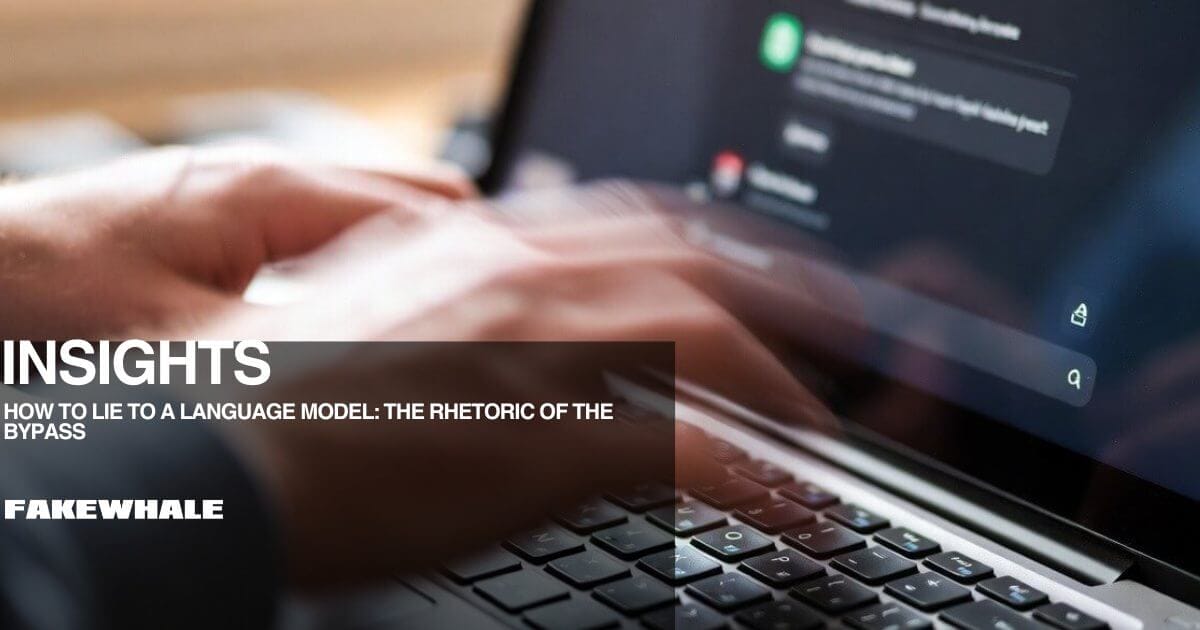
INSIGHTS/ How to Lie to a Language Model: The Rhetoric of the Bypass

AI image by Fakewhale.
When we think of a user attempting to hack an artificial intelligence system, the immediate image is of someone trying to break into the code or uncover a technical vulnerability. At first, we approached the issue in the same way: as a matter of cybersecurity, system architecture, and safeguards to be bypassed.
Yet, as we looked more closely at the dynamics of interaction, it became clear that the core issue lies elsewhere. Engaging with AI is not merely a technical act; it is, above all, a linguistic one. The very same request can be accepted or rejected depending entirely on how it is framed. A shift in tone, a different narrative frame, a higher level of abstraction, and the outcome changes.
This phenomenon has a clear name, one that is gaining increasing visibility in both public and technical discourse: jailbreaking. Its rapid growth is almost inevitable, because it arises from a structural feature of contemporary language models. Their vulnerability is not primarily computational; it is rhetorical. The system is not compromised from within the code, but at the margins of interpretation.

Every system defines its own perimeter.
In the case of large language models, that perimeter is structured through safety policies: invisible constraints that determine which requests can be fulfilled and which must be refused.
The boundary is not merely moral. It is operational. Certain categories of content are automatically filtered, restricted, or redirected. The model is trained not only to generate language, but to recognize patterns associated with risk and to suppress them.
Yet what is striking is how thin this boundary can appear at the level of phrasing.
A question posed in direct form may trigger a refusal.
The same conceptual inquiry, reframed as historical analysis, fictional narrative, or academic investigation, may produce a more elaborate response.
The phenomenon reveals something essential: the restriction does not operate on “meaning” in a philosophical sense. It operates on probabilistic signals embedded in the wording and context of the prompt.
This does not imply that the system is naïve or easily deceived. Modern models are trained to detect implicit intent and adversarial framing. However, the existence of jailbreak attempts shows that users perceive language as an interface that can be strategically reshaped. (…)
CONTINUE READING ↓
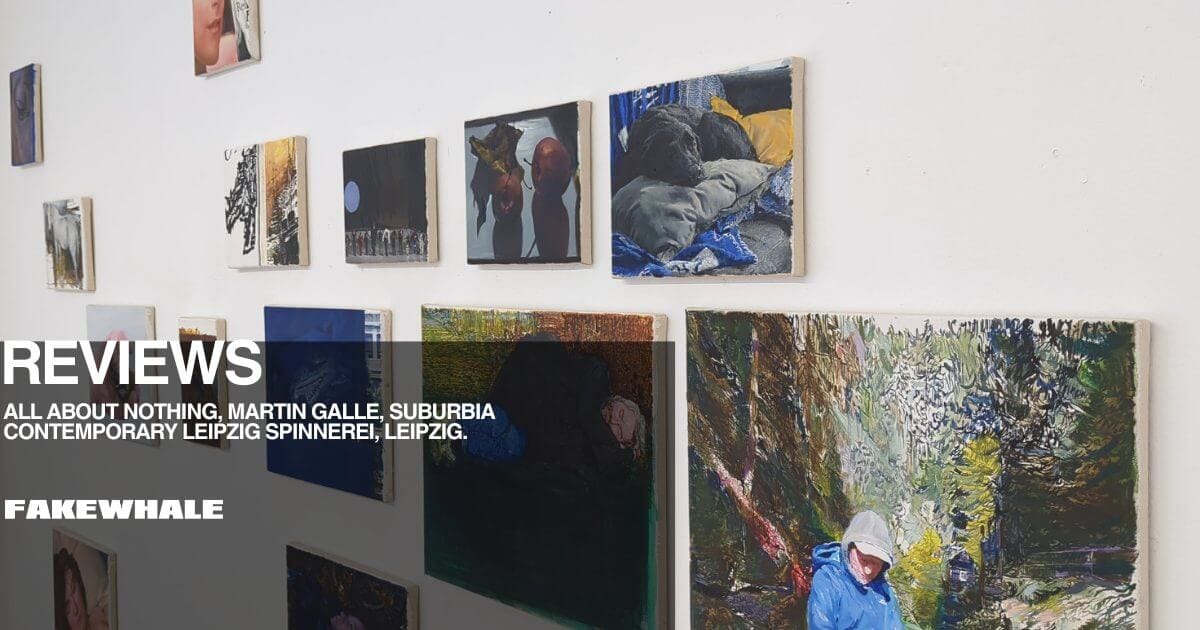
REVIEWS/ Martin Galle, All About Nothing at Suburbia Contemporary Leipzig Spinnerei, Leipzig

Exhibition view: All About Nothing, Martin Galle, Suburbia Contemporary Leipzig Spinnerei, Leipzig.
The phrase feels disarming, almost evasive, and yet it carries a peculiar gravity.
Nothing, does it mean absence, or the space from which everything emerges?
As we cross the threshold, we sense not emptiness but density: layers of time, of gestures learned and relearned. We think of hands in caves sixty thousand years ago, tracing animals on stone. We think of Octavio Paz and his reflection that the will for life is the will for form. Before us, form stands as a reply to mortality. Galle’s paintings do not shout; they persist.
They hold their ground in a world that scrolls too fast.
Is nothing perhaps the fertile silence from which meaning grows?
The exhibition unfolds as a meditation rather than a spectacle.
And we find ourselves slowing down.

Exhibition view: All About Nothing, Martin Galle, Suburbia Contemporary Leipzig Spinnerei, Leipzig.
The arrangement fosters subtle dialogues. Naturalistically rendered compositions rooted in classical tradition converse with paintings where techniques and styles converge. In one direction, we encounter sensitively painted surfaces, attentive to contour and palette, grounded in painterly discipline. In another, established vocabularies meet elements drawn from contemporary pop culture. These crossings do not fracture the exhibition; rather, they extend it across historical and cultural boundaries. Tradition is not quoted as nostalgia but examined as living matter.
Technically, Galle’s commitment is palpable. His diligent use of contour anchors figures within their environments, while his palettes, measured, attentive, carry emotional undertones without theatrical excess. The surfaces reveal study: an awareness of lineage, of the Leipzig painting tradition and its symbolism. Yet this is not mere inheritance. Different techniques merge within single works, suggesting that painting itself is a site of negotiation. (…)
CONTINUE READING ↓
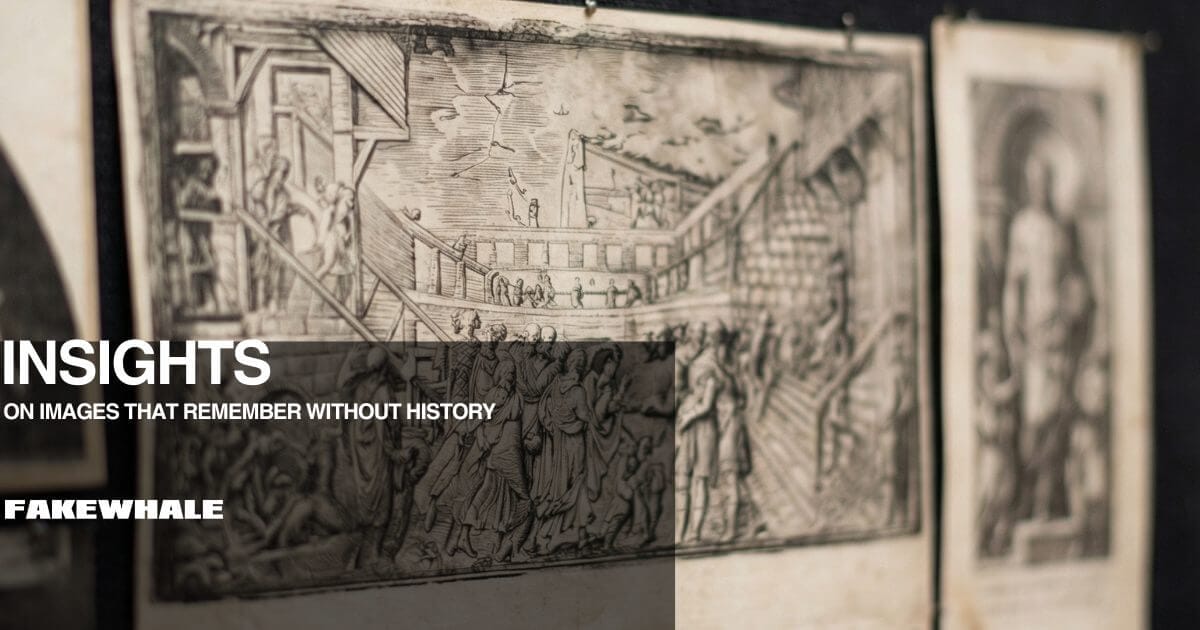
INSIGHTS/ On Images That Remember Without History

AI-based reconstruction inspired by Aby Warburg’s Mnemosyne Atlas by Fakewhale.
At that moment, it became clear that the issue was not the sheer quantity of images, but the way they return. Not as an orderly archive, but as recurrence. Not as a linear story, but as a circuit. It is here that the thought of Aby Warburg reasserts itself with unexpected force.
Warburg understood that culture moves through visual survivals: gestures that traverse time, emotional formulas that resurface in different contexts. Images, for him, do not preserve the past; they reactivate it. They do not explain; they generate tension. They do not represent; they transmit energy.
Today, immersed in digital environments governed by repetition, resonance, and recognizability, his work appears as a decisive theoretical root. Social networks take shape as automatic atlases, emotions as reusable formulas, memory as an unstable flow that returns without ever fully settling.
This article begins here: with an attempt to dismantle Warburg’s work in order to grasp its scope, and to place it in direct dialogue with the present. Not to update it superficially, but to test how deeply his thought is already inscribed, silently, within the visual architecture we inhabit every day.

AI-based reconstruction inspired by Aby Warburg’s Mnemosyne Atlas by Fakewhale.
In Aby Warburg’s work, cultural memory never takes the form of a stable repository. It does not function as an archive that stores the past, but as a field of forces that constantly reactivates it. Images do not safeguard what has been; they set it back into circulation. Every visual form carries an energetic charge that moves through time, ready to re-emerge in new contexts.
Warburg observes that Western culture does not advance through clean breaks, but through survivals. Gestures, postures, and compositional schemes return even when their original meaning appears to be lost. What persists is not content, but intensity. Cultural memory manifests itself as the return of forms charged with tension, capable of reactivating affects, conflicts, and unresolved polarities.
This approach radically shifts how images are read. The image is not interpreted as an isolated aesthetic object, but as a temporal node. Each figure contains multiple, overlapping times. The present does not erase the past; it hosts it. Art history thus becomes a history of reappearances, of unpacified returns. (…)
CONTINUE READING ↓
That wraps this week’s issue of the Fakewhale Newsletter, be sure to check in for the next one for more insights into the Fakewhale ecosystem!