
AI image by Fakewhale.
Last night, before piecing together this new newsletter, we finally reached the end of Dealers in Aura, a book by Alessandro Dal Lago and Serena Giordano that had been waiting on our nightstand for months. We’d started it with that electric curiosity that comes with encountering a new lens on the system, then deliberately left it unfinished. You know that feeling, when certain ideas need to settle, like dust in a beam of light, before they can be fully seen. That’s what we were doing. Letting it breathe. And yesterday, it breathed back.
Because what the book lays bare, methodically, almost surgically, is that aura in contemporary art hasn’t disappeared; it’s mutated. It’s managed. It’s produced. Not by magic, but by an intricate network of actors: curators, collectors, critics, institutions, foundations, markets. The aura, far from dying, has become a resource. A strategy. A performance.
And in this performance, context is everything. An artwork is rarely just an artwork. It is a framed event, a narrative, a position within a field of rules, reputations, and power structures. The invisible scaffolding is part of the piece, as vital as pigment or form. The system doesn’t just surround the work. It co-authors it.
Still, there are cracks. Tensions. Ghost gestures that slip through the frame. And maybe that’s what we’re really after now, not authenticity in the old romantic sense, but signs of escape. Moments when the machinery stutters, when the aura flickers, when meaning isn’t guaranteed.
So we ask ourselves: is there still space for a work that doesn't ask to be certified? Or are we all, in the end, traders in aura, shaping, selling, and buying belief?
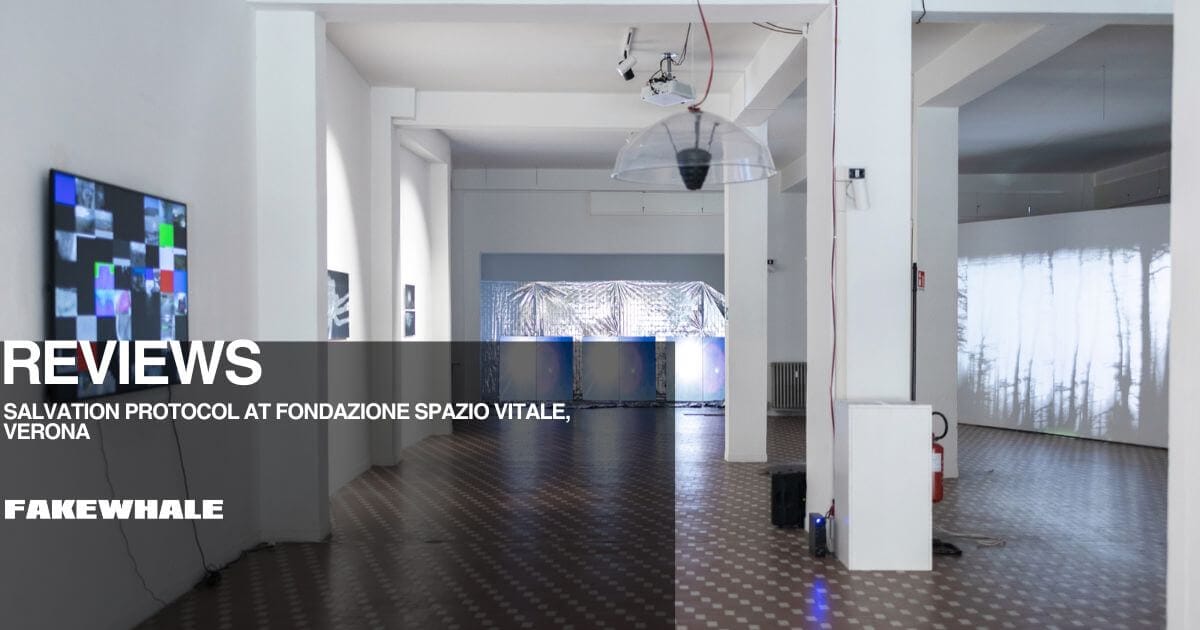
REVIEWS/ TULPA. SALVATION PROTOCOL at Fondazione Spazio Vitale, Verona

Exhibition view: TULPA. SALVATION PROTOCOL, Irene Mathilda Alaimo, Luca Campestri, Giacomo Erba, Gabriele Longega, Beatrice Mika Sakaki, curated by Anastasia Pestinova, Fondazione Spazio Vitale, Verona.
Once, someone told us that spirits prefer faulty circuits. That ghosts, when they want to communicate, don’t choose silence, they choose noise: the hiss of a mistuned radio, a file that opens on its own, a blinking LED with no logic behind it. I dismissed it as low-grade superstition, until I stepped into TULPA. SALVATION PROTOCOL.
Here, the issue is no longer where reality ends and art begins, it’s accepting that the boundary has been infected. The works gathered by Anastasia Pestinova don’t illustrate a theme, they embody it, inject it, let it slither through visitors like an elegant, invisible, seductive malware. This exhibition doesn’t speculate on what could happen; it’s already the aftermath of something that did, but no one managed to record. Or worse, was recorded too well.

Fondazione Spazio Vitale has been reformatted into a sacrificial terminal. You don’t enter it, you access it. The space has the clinical sharpness of a server room, yet the emotional temperature of a séance: low, unstable, dense. Lights are precise and piercing, not ambient. Sounds whisper more than they speak. Some rooms appear empty, until you stand still long enough to feel the surfaces vibrating. As if the walls were listening.
The works aren’t exhibited, they’re summoned. The path is erratic, at times recursive, like a software bug returning you to the same point with slight distortions. In one room, Alaimo orchestrates a microcosm of seemingly dead mobile devices, each quietly emitting signals, performing micro-gestures, simulating life. Campestri works with error, not as failure, but as a creative act: his generative videos display warped interfaces, derailed logic, visuals that resemble the dashboards of some algorithmic cult. Longega and Sakaki dive into electronic mythology: plastic, binaural sound, text fragments flashing like coded threats. Erba, finally, weaves a tapestry of input and output in perpetual flux, a terminal showing the present as the leftover of a future already past. (…)
TULPA. SALVATION PROTOCOL by Irene Mathilda Alaimo, Luca Campestri, Giacomo Erba, Gabriele Longega, Beatrice Mika Sakaki, curated by Anastasia Pestinova, at Fondazione Spazio Vitale, Verona, January 24, 2026 – February 21, 2026.
CONTINUE READING ↓
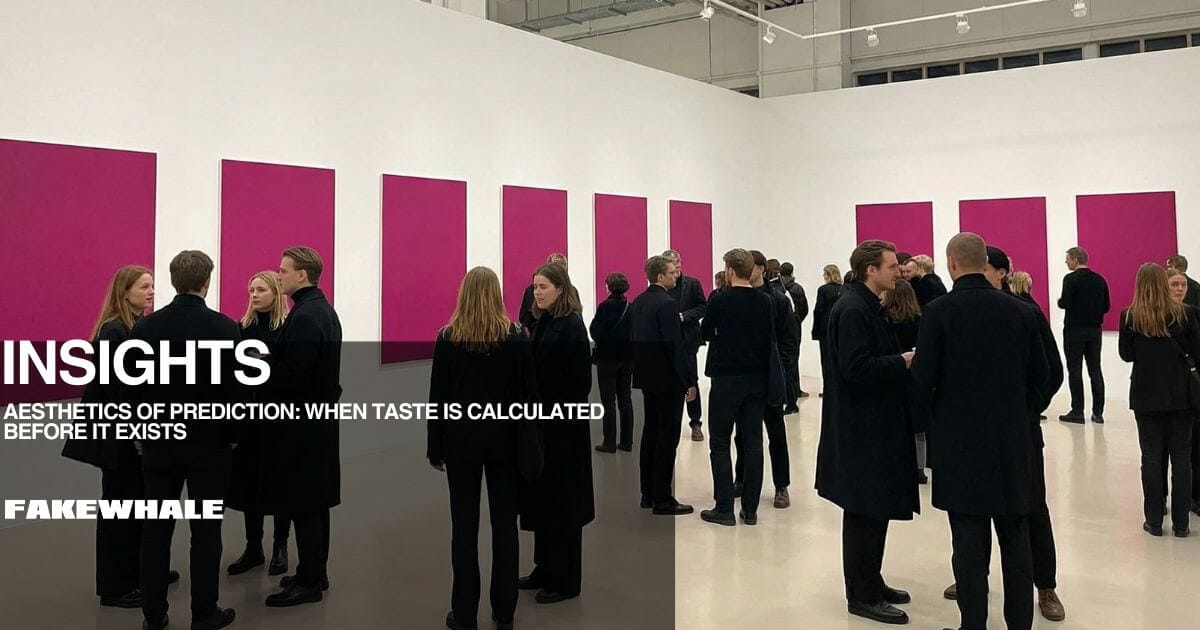
INSIGHTS/ Aesthetics of Prediction: When Taste Is Calculated Before It Exists

AI image by Fakewhale.
Is taste still our own sensation, or in recent years has visual taste increasingly emerged as the outcome of an anticipatory process? Recommendation systems, behavioral analytics, trend forecasting, and automated mood boards often function as devices of aesthetic prediction, indicating what will be desirable before it is even articulated as desire. From social media to blogs, websites, videos, and podcasts, taste takes shape as a calculated probability rather than as the direct result of experience.
It is as if platforms operate as architects of expectation. Every suggested image, every promoted style, every reiterated visual association contributes to constructing a horizon of meaning in which what appears valid, recognizable, and effective is already stabilized. Artistic production thus orients itself within a simulated future that precedes and conditions the present.
The aesthetics of prediction introduces a profound transformation in the relationship between artwork and context. Artists confront models of anticipated reception that define, in advance, the parameters of visibility and compatibility. An inverse feedback dynamic emerges: creative production aligns itself with what the system signals as performant, legible, and circulable. (…)

AI image by Fakewhale.
The aesthetics of prediction rests on a precise technical premise: the analysis of the past as the basis for anticipating the future. Recommendation systems and generative models learn from archives of images, styles, behaviors, and preferences that already exist. Within this framework, the new does not emerge as rupture, but as interpolation. It is a statistical variation on what has already occurred.
This logic therefore produces a form of post-data creativity. Not a creativity that ignores history, clearly, but rather one that remains deeply constrained by it. When the imaginary is constructed from pre-AI datasets, collected before the acceleration of generative systems, the risk is not only repetition, but, over time, saturation. The more efficient the system becomes, the more it tends to explore already dense regions of aesthetic space, avoiding opaque zones that are poorly documented, difficult to classify, or resistant to codification.
The consequence is a compression of the possible. Forms that perform well are reiterated, refined, optimized; those that find no immediate correspondence in the data are discarded or rendered invisible. The aesthetic future is not imagined, but extracted. In this process, evolution gives way to recombination.
The central issue concerns the hierarchical position assigned to data. When past data becomes the dominant criterion of legitimacy, art directs its movement toward confirmation rather than exploration. Creativity then concentrates on perfecting what has already achieved recognition, while attention to what has yet to emerge narrows. The new is accepted only insofar as it appears statistically plausible. (…)
CONTINUE READING ↓
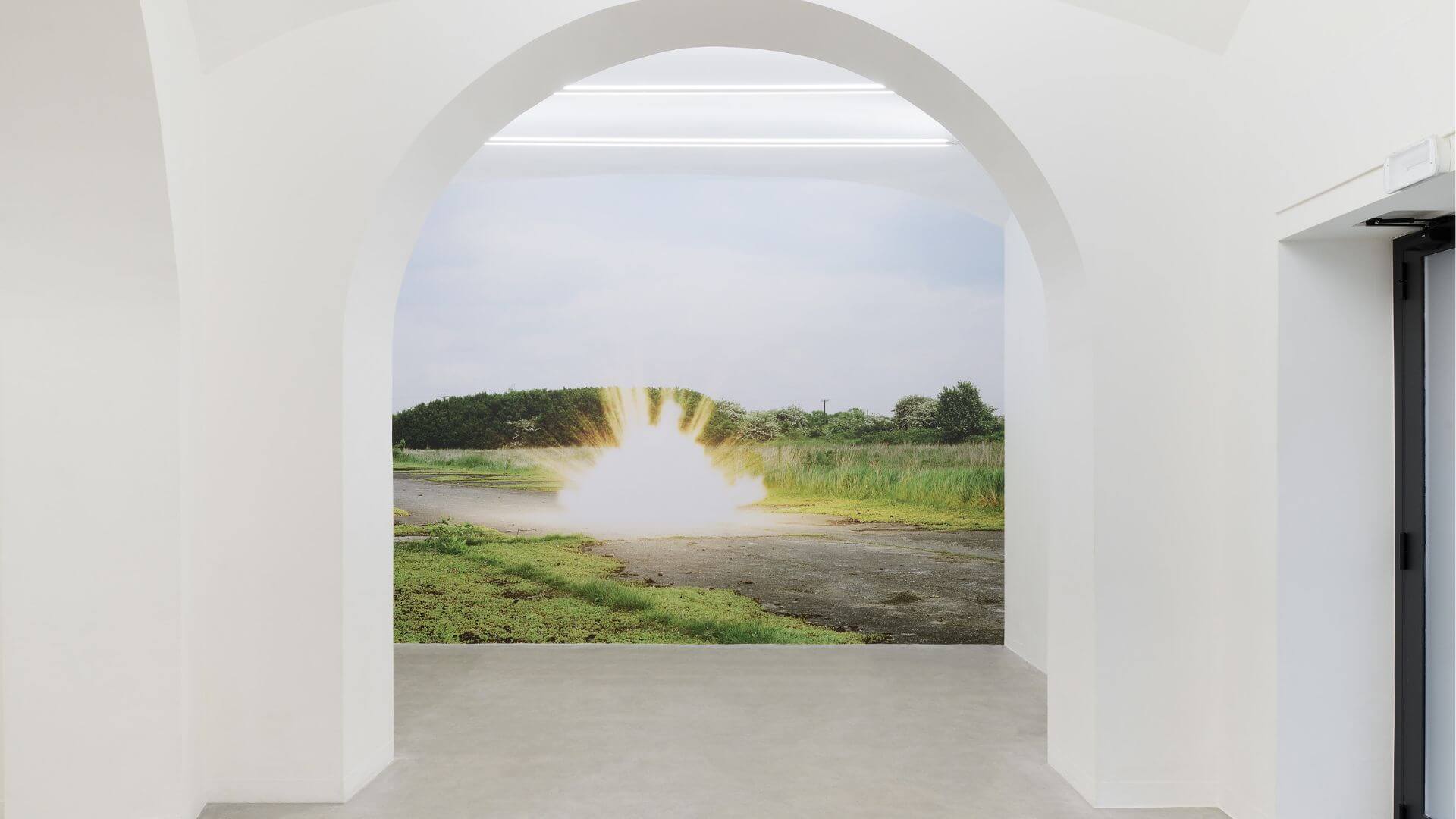
REVIEWS/ Photography, Power and Public Space in Britain at Matèria, Rome

Exhibition view: In Plain Sight: Photography, Power and Public Space in Britain, Anna Fox, Jermaine Francis, Sunil Gupta, Karen Knorr, MacDonaldStrand, Sarah Pickering, John Stezaker, Bettina von Zwehl, curated by Matèria and Christiane Monarchi, Matèria, Rome.
Through the intersection of language and the use of public space, the exhibition explores photography as a transformative site for action and a declaration of intent, whether political, cultural, or personal. At its core, In Plain Sight is both a reflection on Britain’s rich photographic landscape and a testament to its profound contributions to social discourse, with a particular focus on the last twenty years. Bringing together the work of eight lens-based artists, In Plain Sight opens a dialogue with specific histories of the United Kingdom which continue to influence visual culture today. The photographs, video, and sculptural works included from these UK-based artists oscillate between fiction and document, while remaining conceptually grounded in the experience and existential analysis of contemporary culture in Britain, where it originated and from where it ventures abroad.
The exhibition also resonates with the history of Matèria itself, tracing back to the formative years its director, Niccolò Fano, spent in the UK during the 2000s. More than a survey, this selection is deeply personal, shaped by the artistic influences and relationships built during that time, most notably the long-standing dialogue with curator and editor Christiane Monarchi, with whom Fano has collaborated on multiple occasions, and the ongoing relationship with artists Karen Knorr and Sunil Gupta, both featured in the exhibition.

Monarchi’s expertise in photography is extensive. She is the co-director of HAPAX, which publishes a biannual print magazine commissioning new photographic ideas and runs a project space in London. She also founded Photomonitor, which has published over 1,400 online features since 2011 and has commissioned new writing in partnership with the University for the Creative Arts. A publisher, editor, curator, lecturer, and artist mentor, Monarchi also serves on the steering committee of Fast Forward: Women in Photography and is a trustee of the Centre for British Photography.
Among the works on view, Anna Fox’s Friendly Fire (1989) critiques the performative rituals of Thatcher-era leisure. Documenting paintball games undertaken by corporate teams and social groups, Fox mirrors the absurdities of simulated combat against the backdrop of post-industrial Britain. The work exposes how play and violence, spectacle and critique, coalesce within the social fabric, transforming the photographer herself into both observer and reluctant participant. (…)
CONTINUE READING ↓
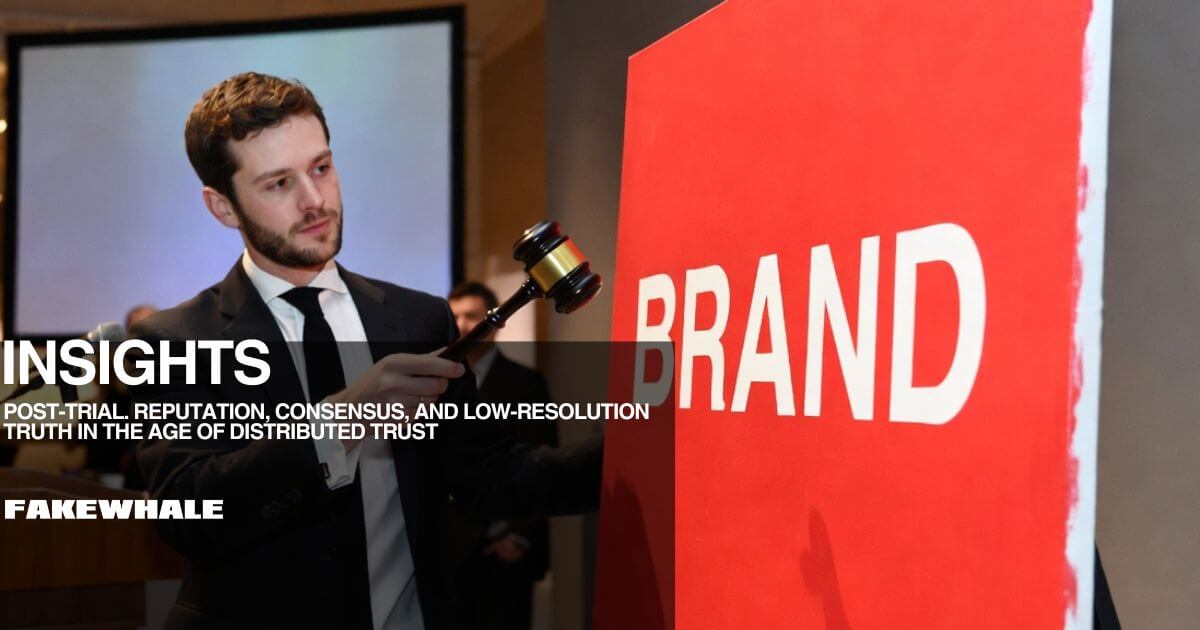
INSIGHTS/ Post-Trial. Reputation, Consensus, and Low-Resolution Truth in the Age of Distributed Trust

AI image by Fakewhale.
For a long time, visual evidence functioned as one of the primary infrastructures of trust. To see was to believe. The image, the document, the visible trace operated as guarantees of truth, as immediate confirmation of a fact, an event, an existence. This regime rested on a linear assumption: what is visible is verifiable, and what is verifiable is reliable.
Today, this assumption is undergoing a profound transformation. The image has become a field of ambiguity. Its total reproducibility, together with practices of manipulation, generation, and simulation, has redefined the function of visual evidence, rendering it structurally unstable. The image has entered a new condition: it shows, but it does not guarantee; it exposes, but it does not certify. Vision alone no longer grounds trust, which now unfolds across additional layers.
This transformation concerns the cultural construction of truth itself. When every image can be authentic or artificial, documentary or synthetic, the distinction loses its operational relevance. The central issue becomes the capacity of something to appear credible, sustainable, and shareable within a given context.
In the post-evidence regime, the image changes function. It signals rather than proves. It orients rather than certifies. It operates as an access point to a network of relations, narratives, and external confirmations. Trust is produced through the continuity between what is shown and the symbolic system that supports it.

AI image by Fakewhale.
With the eclipse of visual proof as the foundation of certainty, truth acquires a new status. It takes shape as a process: a shared construction that emerges through relationships, repetition, and mutual recognition. In this sense, truth increasingly functions as a social protocol.
A protocol regulates. It defines the conditions under which something can be considered valid, reliable, and operative. Likewise, post-proof truth operates through adherence. It is accepted because it aligns with a shared system of signs, behaviors, and expectations. It therefore assumes a functional character.
This transformation shifts the center of trust from the object to the context. Attention moves toward the recognition of something as true within a sufficiently stable network of subjects. Truth emerges from the interaction of reputation, temporal continuity, and implicit consensus. It takes the form of a negotiation.
In the field of art, this mechanism is particularly evident. A work gains credibility by being embedded in a system of distributed validations: curators, venues, collectors, reference communities. The truth of the work coincides with its capacity to hold within this system over time. (…)
CONTINUE READING ↓
That wraps this week’s issue of the Fakewhale Newsletter, be sure to check in for the next one for more insights into the Fakewhale ecosystem!


1