
Fakewhale Studio, OUTPUT y 108
Money smells of rotting sugar.
It corrupts at low temperatures, like honey left out in the sun.
It seeps into the pores of intention, slicks the fingers before the touch ever happens.
He knew this. He wanted it, too, what artist doesn’t?
But he wanted it like one craves a disease that might finally make them visible.
He built nothing:
Objects that could not be signed, performances with no beginning, no end, no trace.
He kept cash in his pockets and let it slip into storm drains.
He used to say: “If you can’t burn it, it owns you.”
Once he painted a 500-euro note on a canvas, then left it in his studio for weeks,
untouched, unguarded, unbothered.
On another, he scrawled “sponsor me” across the back of a dead pigeon.
No one understood. Or pretended not to.
Maybe he only wanted to sabotage his own future just enough to make it finally feel alive.
Maybe he was just tired.
Maybe the flower in the bottle was a bribe for the saints, to not be saved.
And what if the real scandal was refusing it, the stage?
Or worse: believing that honesty might actually matter.
No one understood.
Or pretended not to.
Meanwhile, he was busy building nothing.
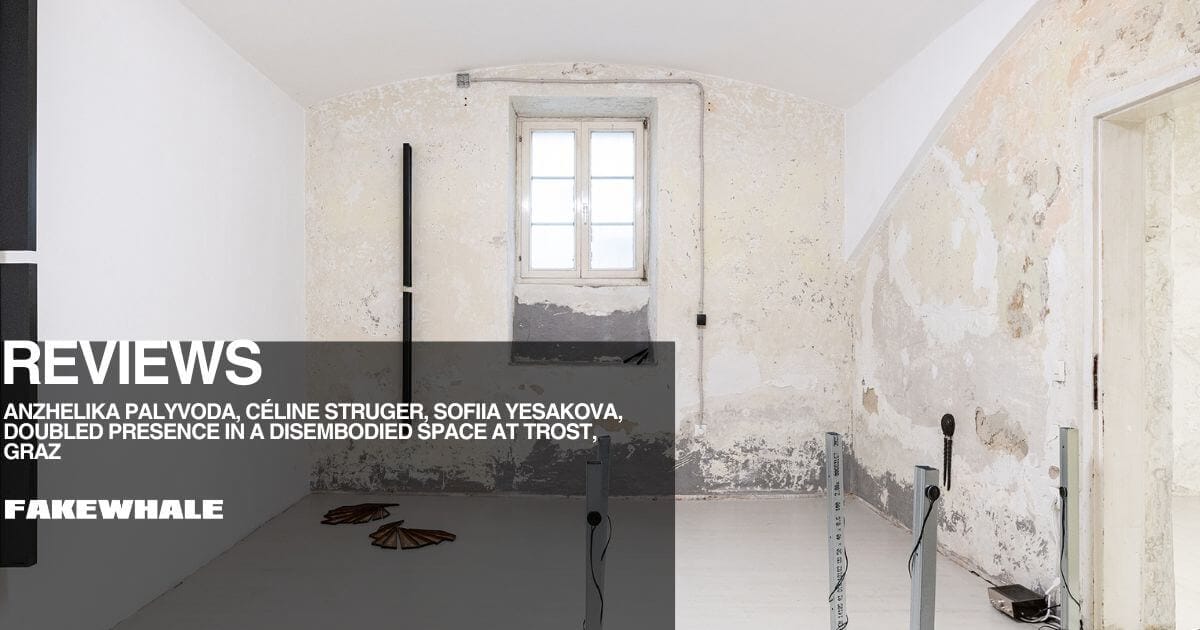
REVIEWS/ Anzhelika Palyvoda, Céline Struger, Sofiia Yesakova, Doubled presence in a disembodied space at TROST, Graz

Exhibition view: Doubled presence in a disembodied space, Anzhelika Palyvoda, Céline Struger, Sofiia Yesakova, curated by Markus Sworcik and René Stiegler, TROST, Graz. ©Tom_Biela
How do you inhabit a body that is no longer there? And what truly remains when matter becomes a relic, when the image stops representing and starts leaking absence?Entering TROST in Graz feels like stepping into the gap between presence and ghost, a charged emptiness, ready to vibrate. The title “Doubled Presence in a Disembodied Space” sounds like a paradox, a strange formula that suggests being and disappearing at once. Deleuze’s ideas drift through the room like a quiet rhythm: repetition, difference, echo. But here, philosophy becomes physical, or what’s left of it, through the shared work of Céline Struger, Anzhelika Palyvoda, and Sofiia Yesakova. Three artists, like overlapping voices, appearing and vanishing in the same space.

Exhibition view: Doubled presence in a disembodied space, Anzhelika Palyvoda, Céline Struger, Sofiia Yesakova, curated by Markus Sworcik and René Stiegler, TROST, Graz.©Tom_Biela
The setup is quiet, but not calm. Flickering lights reflect on rough surfaces, casting shadows that seem more solid than the works themselves. The mood is part shrine, part laboratory. Every piece, a fragment, a bone, a reflection, feels placed not to show itself but to hint at something missing. This isn’t a show to walk through quickly, it asks to be studied, watched slowly, almost listened to. The works aren’t arranged to tell a story but to infect the space. The viewer becomes a quiet witness, drawn into something already underway. The artworks don’t speak to each other directly, they reflect, distort, and sometimes cancel one another out.
Technically, everything is pared down. The shapes are strict, as if holding in something emotional. The lines are fine and delicate, the materials, bone-like, see-through, fibrous, act more like skin than structure. Nothing is solid, nothing truly empty. The artists push their materials to reveal what lies beyond them. Plaster, wax, metal, fabric, they don’t build forms, they expose tension. Each piece is a symptom, a remnant, a clue. Together, they feel like a sacred inventory, less like artworks and more like secular relics. Struger, Palyvoda, and Yesakova work like modern icon-makers, not drawing holy figures but dissecting memory. Every gesture feels like it comes after the fact, every image is a leftover, a trace. (…)
“Doubled presence in a disembodied space” by Anzhelika Palyvoda, Céline Struger, and Sofiia Yesakova, curated by Markus Sworcik and René Stiegler, at TROST, Graz, 11/12/2025 — 23/01/2026.
CONTINUE READING ↓
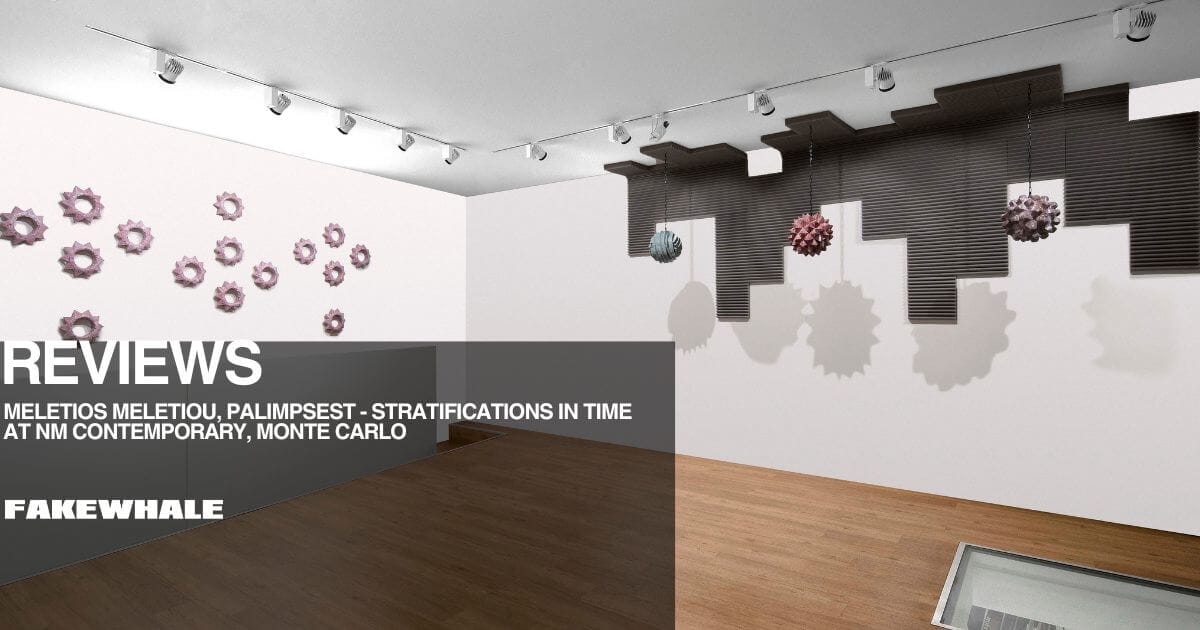
REVIEWS/ Meletios Meletiou, Palimpsest – Stratifications in Time at NM Contemporary, Monte Carlo

Exhibition view: Palimpsest - Stratifications in Time, Meletios Meletiou, curated by Alessandro Cazzola, NM Contemporary, Monte Carlo.
Every urban fabric is a living archive. Its surfaces, walls, pavements, ornamental elements, store layered information, much like the stratified levels of an active archaeological site. Decorative motifs, control devices, architectural solutions all bear witness to a material culture that evolves without ever fully erasing what came before. In Palimpsest – Stratifications in Time, Meletios Meletiou adopts a nearly geological method: he excavates, extracts, repositions, reframes. This exhibition is not a display in the conventional sense, but a sequence of clues. Each work is a fragment to be read in its tension between function and memory, between beauty and constraint.
Meletiou, a Cypriot artist born in 1989, conceived the entire body of work presented at NM Contemporary in Monte Carlo as a coherent yet open-ended ensemble. Though the pieces belong to distinct series (Chronotypes, Traces, Resize to Fit, and Meteore), they don’t unfold as chapters of a linear narrative. Instead, they present themselves as samples from an ongoing investigation. The consistency of materials and techniques reinforces this: casts, tear-away surfaces, concrete, dense pigments, and rough textures become tools of a writing that engraves more than it illustrates. For Meletiou, the palimpsest is not just a concept, it’s a method. (…)
Palimpsest – Stratifications in Time by Meletios Meletiou, curated by Alessandro Cazzola, at NM Contemporary, Monte Carlo, November 6, 2025 – January 6, 2026.
CONTINUE READING ↓
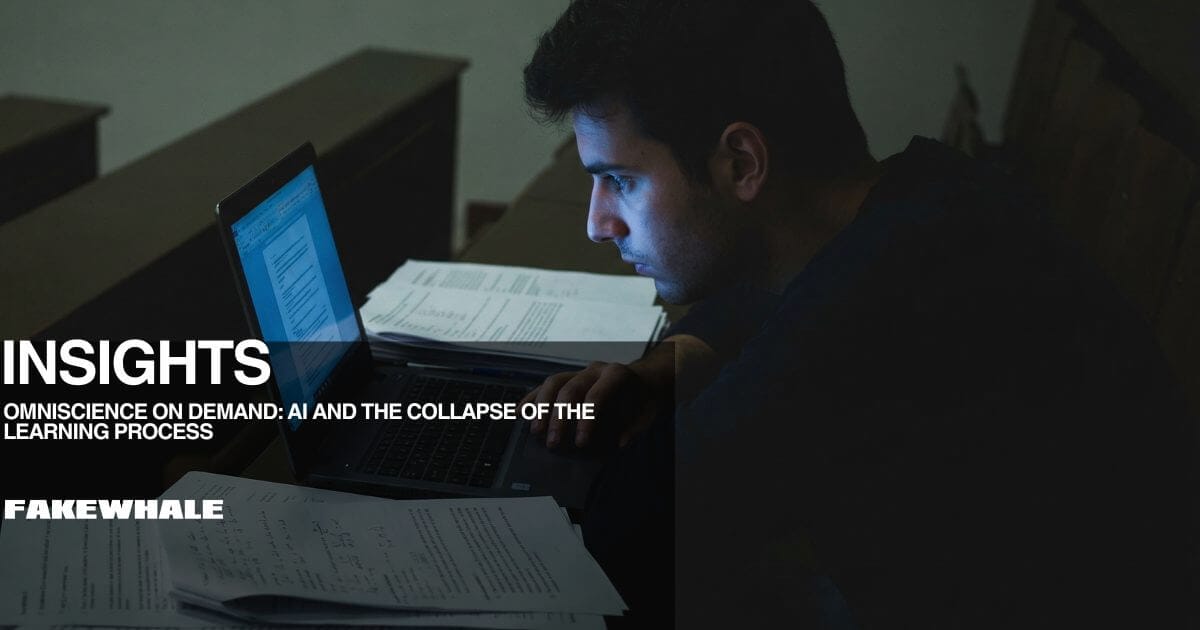
INSIGHTS/ Omniscience on Demand: AI and the Collapse of the Learning Process

A photo showing a young man working late at night on a laptop, surrounded by printed documents, illuminated only by the screen’s blue light. AI image by Fakewhale.
In recent years we have been witnessing a profound transformation in the relationship between knowledge, the subject, and the notion of limit. Artificial intelligence has entered the field of learning as a dominant presence and as an already complete cognitive environment, one in which knowledge is no longer constructed but, rather, interrogated. Within this silent yet substantial shift, the act of learning loses its transformative nature and takes the form of an extractive operation. Education, historically grounded in lack, error, and duration, is progressively emptied of its friction. What once required time, exposure, and failure now appears immediately available, synthesizable, and solvable. Knowledge no longer inhabits the individual; it surrounds them.
This condition generates an unprecedented perceptual effect. The sensation of having no gaps, of never encountering opaque zones, of being able to answer any question produces an illusion of functional omniscience. This is not a true expansion of the intellect, but a continuous act of delegation that dissolves the boundary between what is understood and what is merely accessible. It is within this confusion that a new posture emerges: feeling like “gods” not through power, but through access.
The article that follows seeks to examine the consequences of this transformation on the educational process, on awareness of one’s internal capacities, and on the ability to inhabit the limit. Because it is precisely within the limit, rather than in its erasure, that thought has always found its form.

A photo showing a laptop screen open to ChatGPT. AI image by Fakewhale.
Learning takes on a reactive form. The subject becomes accustomed to receiving instructions, solutions, pre-defined paths. Within this configuration, the construction of an internal method loses centrality. Procedural memory weakens, while trust in technical mediation increases. Thought adapts to an environment that constantly suggests what to do.
This condition produces a structural fragility. The absence of internal tools makes the subject efficient in stable contexts and highly vulnerable in ambiguous situations. Cognitive autonomy depends on the presence of the interface. Personal knowledge is reduced to a set of triggers, commands, and well-formulated requests. (…)
CONTINUE READING ↓
INSIGHTS/ The End of Function

A photo showing a hand holding a RAM memory module against a neutral background. AI image by Fakewhale.
The acceleration of artificial intelligence models is commonly interpreted as a threshold of loss: loss of human centrality, of work, of identity, of meaning. This reading, however, remains anchored to a historical conception of the human as a subject defined by operativity, function, and the necessity of self-automation in order to survive.
In this article, we seek to radically overturn that perspective. Artificial intelligence is not treated here as an agent of dehumanization, but as the catalyst of a structural liberation: the possibility, for the human species, to progressively shed the cognitive and psychic burden tied to automatism and to reactivate latent potentials that have remained inaccessible for centuries.
What is perceived today as a threat coincides, in this reading, with the end of a long evolutionary phase in which the human being was compelled to sacrifice deep dimensions of creative, contemplative, and inventive capacity to the necessity of operating, producing, and functioning. By delegating the entire domain of operativity to AI, the possibility opens for a more radical transformation: the re-emergence of the human as creator, not by role or profession, but by ontological structure.

Photo showing a computer monitor displaying a batch script and command-line instructions. AI image by Fakewhale.
The misconception arises from an improper overlap between identity and operativity. For centuries, the human had to coincide with what it did, because individual and collective survival depended directly on the ability to execute tasks, repeat gestures, and optimize processes. In this context, automatism was not a choice but an evolutionary necessity. The mind structured itself to respond to practical problems, to reduce uncertainty, and to render the world predictable and controllable.
The fear of dehumanization emerges precisely when this structure enters into crisis. What AI makes visible is a deeper fact: much of what we have called “human” was in reality an adaptive function. When that function becomes delegable, identification collapses, not because the human is emptied out, but because the conceptual void on which its self-definition rested is exposed. (…)
CONTINUE READING ↓
EXPLORE THE LATEST ARTICLES ↓

That wraps this week’s issue of the Fakewhale Newsletter, be sure to check in for the next one for more insights into the Fakewhale ecosystem!


1