Fakewhale Studio, Output XA237, 2026
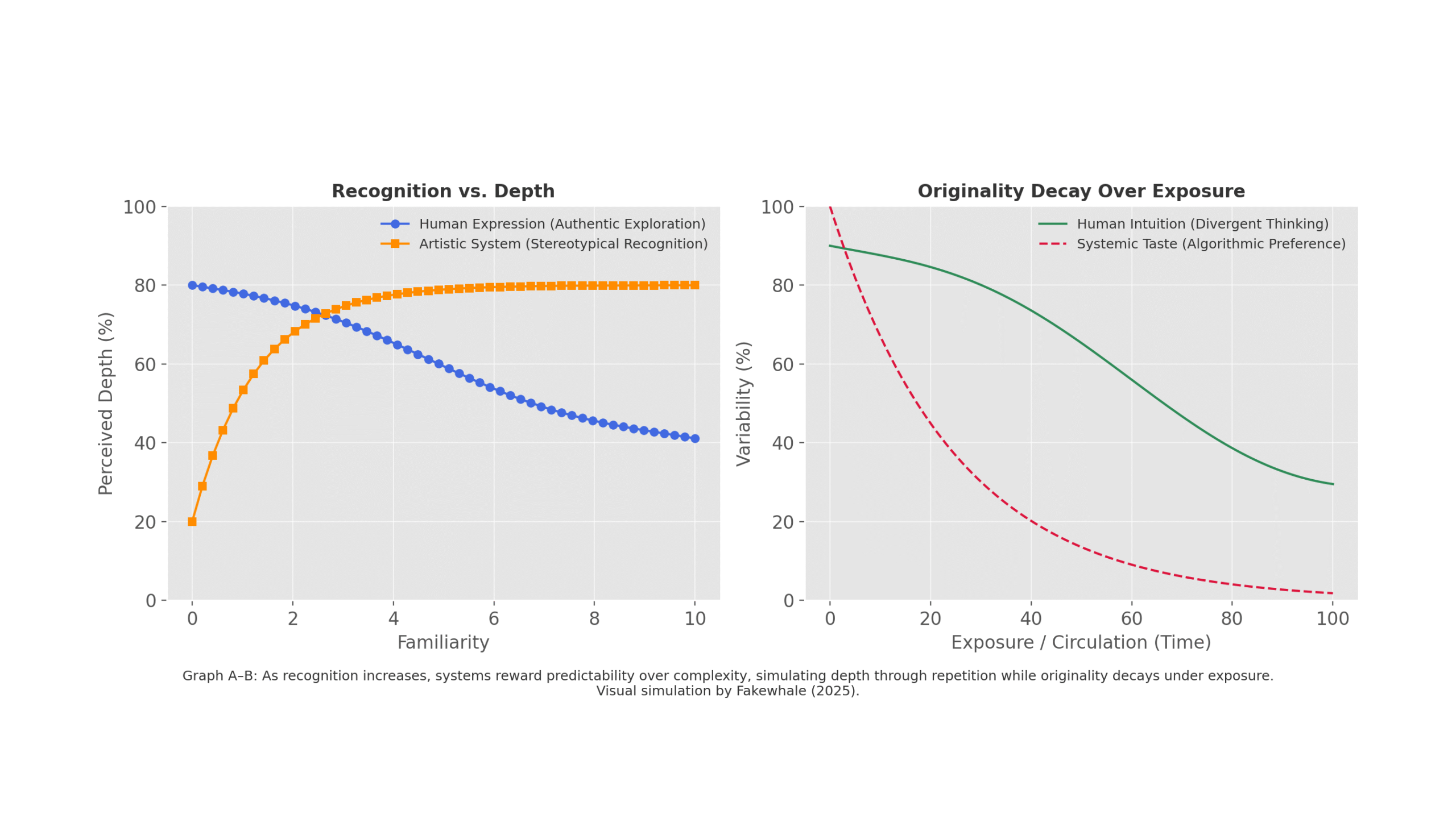
The first time we encounter a sign, it appears as an intrusion, an alterity that must be decoded and processed through cognitive effort; the tenth time, that same sign has already transformed into a reassurance, a mnemonic trace that requires less energy to be accepted and which, precisely because of this metabolic saving, is gratified by the neural reward system. This predisposition toward recursion is not simply a lazy biological automatism, but the foundation upon which the entire scaffolding of collective taste rests. If we analyze the trajectory of what we define as ‘iconic,’ we realize that an icon rarely arises from an absolute and isolated singularity; instead, it feeds on a relentless dissemination that smooths its edges and standardizes its reception. (…)
The Compass and the Cage: Anatomy of Critique After Opinion

Fakewhale Studio, Output XA238, 2026
The transition of aesthetic perception from the static plane of museum contemplation to the frenetic verticality of the digital feed in recent years represents not a mere variation in medium, but an ontological mutation of the act of looking.
If theFor a long time, critique appeared as a compass. An instrument of orientation, a faculty capable of distinguishing, ordering, separating truth from falsehood, relevance from noise, territory from interference. Within this confidence, a deeper promise took hold: that drawing boundaries produces understanding, that naming sharpens vision, that articulating judgment allows a more lucid inhabitation of the world.
A powerful promise. A reassuring one as well.
Every map generates this effect. It reduces the friction of the real, simplifies its surface, converts instability into trajectory. It delivers the impression that whatever becomes legible also becomes governable. Coordinates attract for this reason. Clean lines, thresholds, categories. They sustain the belief that thought coincides with a firmer grasp on things.
Then the ground shifts.
When this same logic meets lived experience, perception, interior states, art, the relation to technology, the mind itself, the clarity of the map begins to fracture. The boundary ceases to register as conquest and starts to appear as incision. Classification extends beyond orientation and performs selection, compression, hierarchy. It organizes the real while thinning its density. Within that passage, the compass already carries the outline of the cage. (…)

Fakewhale Studio, Output XA240, 2026
The value of judgment historically relied on two conditions: internal coherence and the presence of a subject assuming the risk of enunciation. Judgment functioned as linguistic construction and positional act.
Artificial intelligence intervenes within this balance.
Generative models produce statements that satisfy coherence, structure, contextual pertinence, argumentative continuity. The subjective anchor recedes. Exposure, in its classical sense, dissolves. The friction between statement and presence diminishes within parameter space and training bias.
The central issue concerns separation. Legibility detaches from subjectivity. (…)
Explore the full Article↓
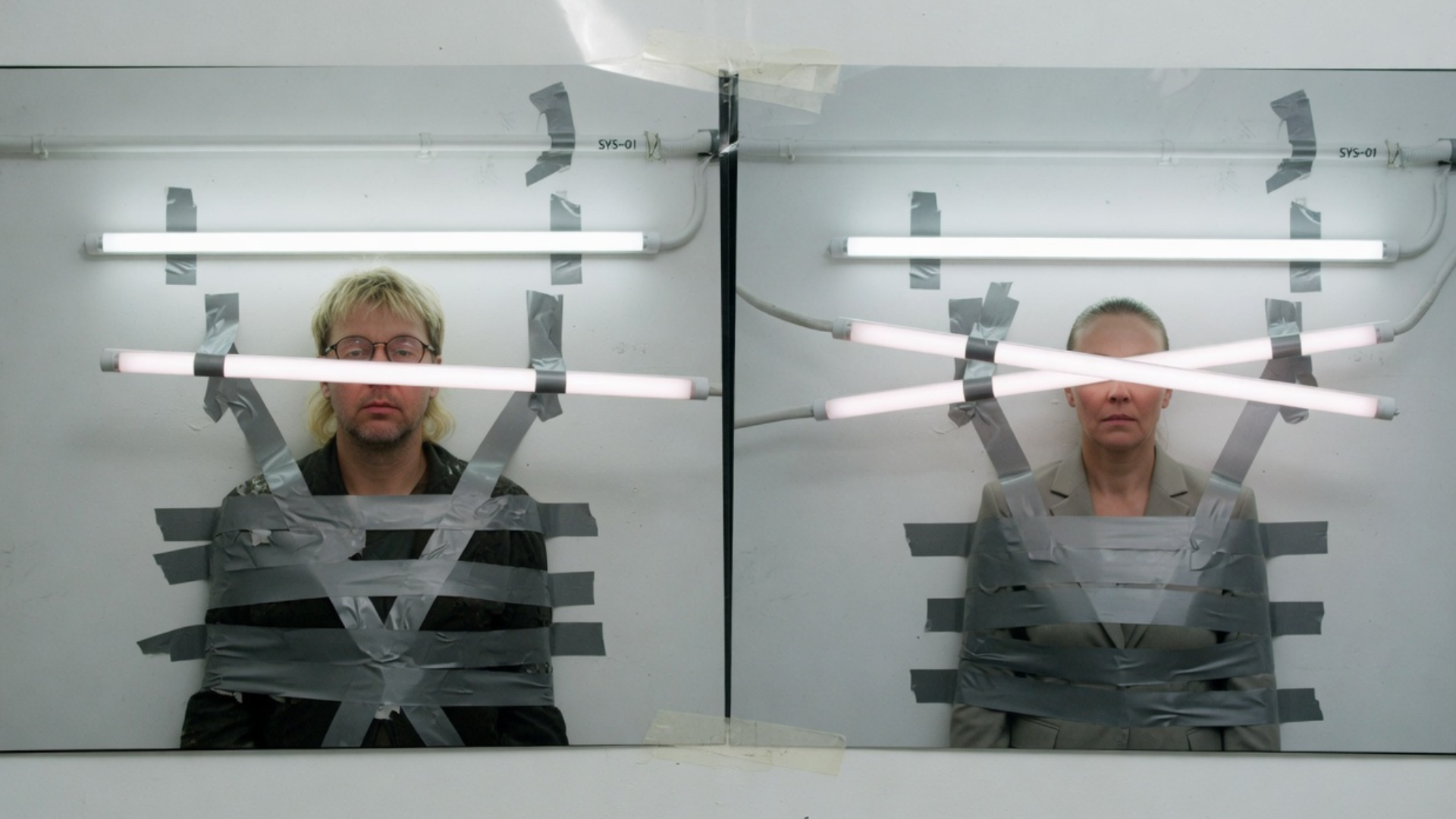
Fakewhale in Dialogue with Leon Billerbeck

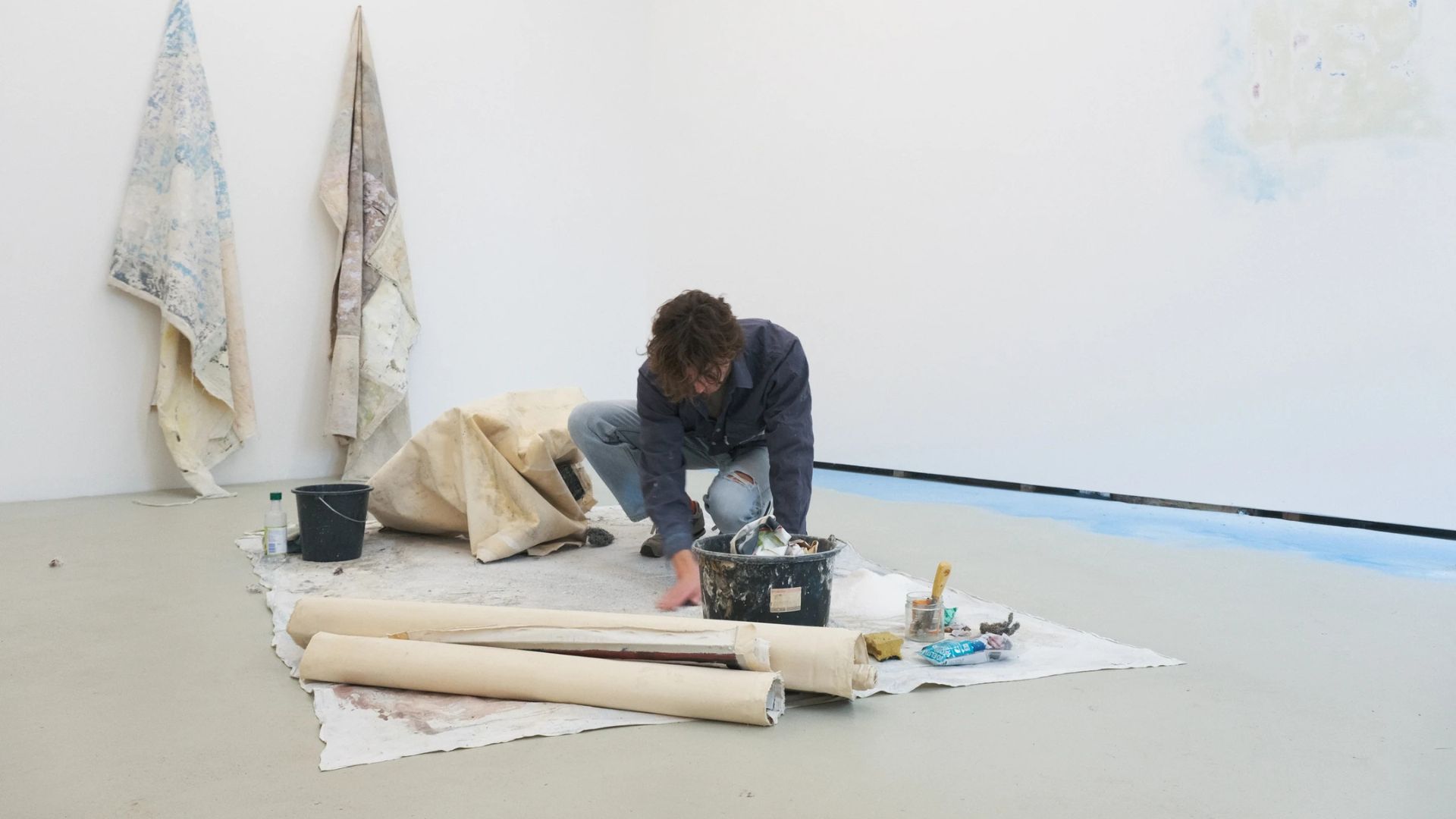
Soaking–washing–rubbing–scraping (performance), textiles, oil and acrylic paintings, water, salt, soaps, brushes, sponges, scraper, blade, buckets, variable dimensions, 2024. © Leon Billerbeck
Leon Billerbeck is a German artist working across photography performance and installation. His practice reflects on image production in a digital age shaped by excess accumulation and constant circulation.
Through processes of deletion transformation and material experimentation he explores the relationship between digital archives memory and the body. His work often turns everyday gestures into reflective and ritual like actions.
In this interview we discuss his approach to absence materiality and the role of art in a world saturated with images. (…)

„2251 deleted photos and videos“, tripod, LCD-screen, video loop, 200x75x75cm, 2024. © Leon Billerbeck
You work across photography performance and installation how did this interdisciplinary approach develop for you?
Since my first creative output as a young teenager was poetry and music, which I performed on stage, and photography and video started to be a practice that I was interested in very early as well, I was always kind of interested in everything. In the beginning I was mostly working on photography or film projects though, and producing music at the side, as a separate thing. But over the years I noticed that there is no need to separate everything, that It can work together. And I think this is very I got more interested in performance and installation art, since it opens up this platform to bring diverse things together.
Your work often engages with ideas of deletion reduction and absence are you more interested in removing images or transforming them into something new?
This is the core question of my recent work I think. I cannot answer it yet, and maybe never will. But Jean-Paul Sartre said something interesting about this in « Being and Nothingness » . He says, that no condition of being can ever be nothing, but that nothingness is rather the constant change of states, the transformation from one being to another. And I realized the same thing in my processes and trials to erase, delete, deconstruct, that I am always left with something after. The object is not gone, it has transformed. So a certain kind of failure always takes place. And at this very thin line between transformation , presence and absence, my work is situated I think. And somewhere near there, I assume something like « emptiness ». (…)
Explore the full Dialogue↓